What is Polar Capitalism?
From pre-polar to polar capitalism
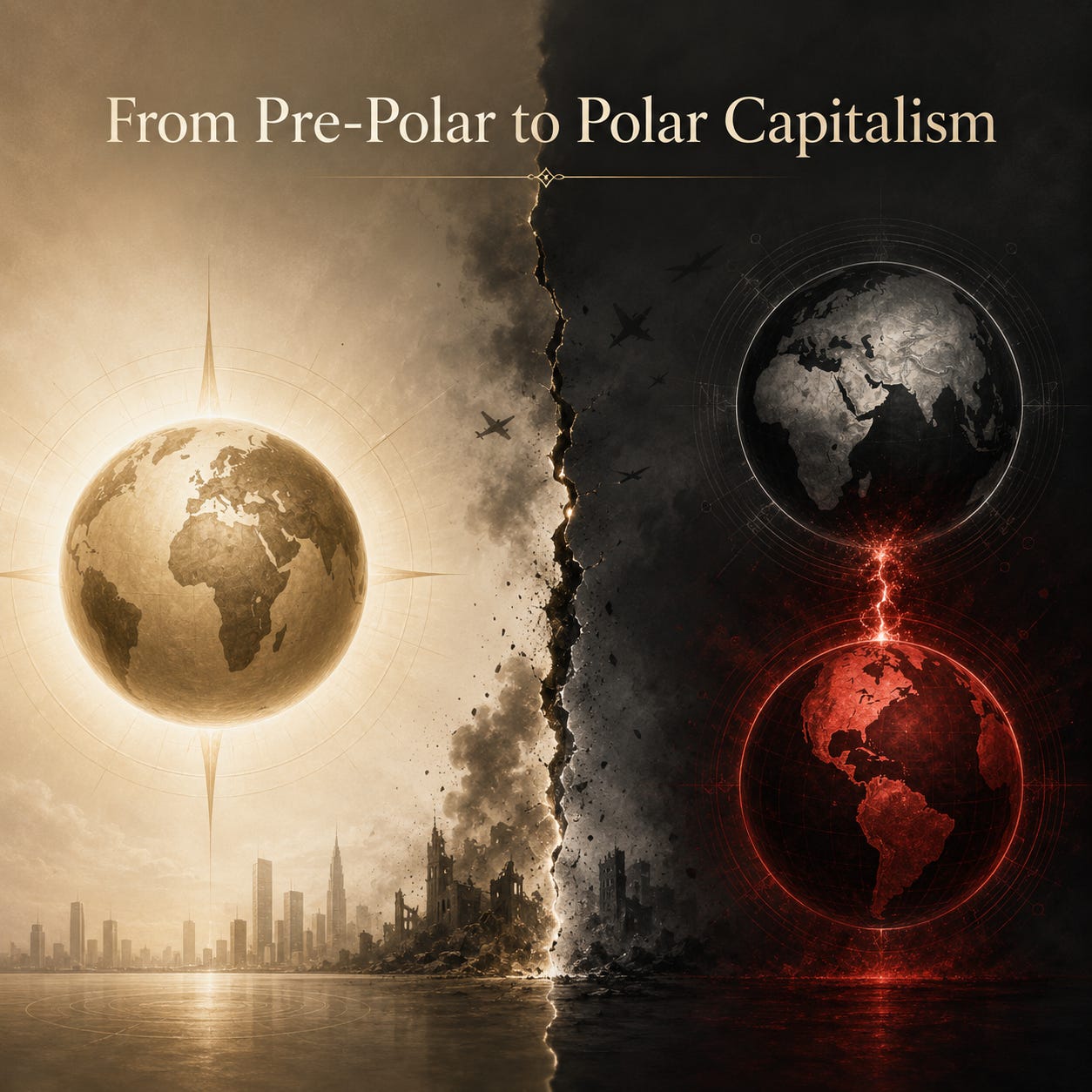
Before polar capitalism, the world was essentially unipolar. Capitalism developed as a single world movement centered on the capitalist core. This movement produced imperialism: the concentration of capital, power, resources, and historical initiative in the center and the subordination of the rest of the world to that center.
Pre-polar capitalism is the historical form of capitalism before the emergence of anticapital as an organized world pole.
This pre-polar world reached its limit in the early twentieth century. Capitalism arrived at the maximum intensity of exploitation, concentration, and imperial expansion. This limit produced the crisis of capitalism.
The Crisis of Capitalism is the historical moment when capitalism reaches the limit of its own development and enters a world crisis.
In the old Marxist expectation, this crisis could appear as the final collapse of capitalism. Capitalism reaches its limit, the contradiction becomes unbearable, and the old order falls. But history showed a more complex movement. Capitalism does not simply disappear by reaching crisis. Its crisis produces two opposite results at the same time.
The first result is the second breath of capital. World wars become the mechanism through which capital resets its own counter. Destruction, redivision, militarization, and reconstruction allow capital to begin a new cycle of accumulation. The level of capitalist development remains, but the accumulated pressure is thrown backward. Capital receives time.
The second breath of capital is the temporary renewal of capitalism through world war, destruction, and the geographical displacement of its contradictions.
This second breath does not save capitalism in any final sense. It delays the end of capitalism by moving its contradictions through geography. Capital resets itself, but the reset itself creates the conditions for a stronger future opposition. The same movement that extends the life of capitalism also prepares the force that will eventually overcome it.
The second result is the birth of anticapital. The crisis of capitalism tears open the periphery. It breaks old social forms, intensifies exploitation, creates revolutionary situations, and gives rise to socialist power, national liberation, and anti-imperialist development. The twentieth century and the twenty-first century both come from this rupture.
Anticapital is the historical opposite of capital: a real mode of development that arises from the periphery against imperialist domination.
Anticapital is not simply an anti-capitalist opinion or a moral rejection of capitalism. It is a real historical force and a real mode of production. It appears where the periphery begins to resist imperialism, organize sovereign development, and build forms of power outside the direct logic of capital.
The first great center of anticapital was the Soviet Union. It became the first historical form of socialism, or more precisely, the Revolutionary Dictatorship of the Proletariat: RDP of the First Type. The Soviet Union was the highest organized expression of the first wave of anticapital.
RDP of the First Type is the Soviet form of real socialism: the first organized historical center of anticapital.
The next great center became China. But here the decisive form is not simply China before Deng Xiaoping. The China that becomes the second great form of anticapital is the China that emerges through Deng’s transformation and develops into the present Chinese structure. This is the second great form of RDP.
RDP of the Second Type is the Chinese form of real socialism: the second organized historical center of anticapital, built through anti-market development.
Polar capitalism begins from this split. Capital remains centered in the imperialist core. Anticapital rises from the periphery and takes organized historical form in the Soviet Union and then in Dengist China. From this point, the world is no longer simply capitalist. It becomes polar.
Polar capitalism is the epoch in which the world is structured by the contradiction between capital and anticapital as two historical poles of development.
Against false interpretations
Different traditions understand this split in different ways. Old Soviet dogmatic Marxism, or gross Marxism, treats the Soviet Union and China simply as socialism, where socialism means the first stage of communism. In this view, the Eastern side of the world has already entered the communist path in a direct sense.
Polar Marxism gives a more precise definition. The Soviet Union and China are not communism, and they are not “the first stage of communism” in the simple old sense. They are historical forms of anticapital. More precisely, they are forms of the Revolutionary Dictatorship of the Proletariat: the RDP of the First Type in the Soviet case and the RDP of the Second Type in the Chinese case.
This distinction matters because the East remains less developed than the West. The West is still the more developed pole, and it remains capitalist. If the East reaches the same level of development as the West, that fact alone does not make the East communist. The West already has that level of development while remaining capitalist. Development inside one country, or even inside one side of the world, is not communism by itself.
Western liberal and academic theories make another mistake. They often describe the same polar reality as two forms of capital: liberal capitalism against authoritarian capitalism, democratic capitalism against state capitalism, and Western capitalism against Chinese capitalism. These theories see the surface forms, but they miss the deeper relation. The real opposition is not between two styles of capitalism. It is between capital and anticapital.
The same applies to the idea of a multipolar world. On the surface, the world may appear multipolar: many states, many centers, many regional powers, many organizations. But the deep structure is polar. BRICS itself already shows this. It appears as a plural bloc, but its historical meaning is the formation of another pole against the Western pole. The world has many states, but the epoch has two historical poles.
The political appearances also follow from this polarity. The West appears through liberal democracy, civil society, markets, and private capital. The East and the periphery often appear through centralized power, dictatorship, authoritarianism, or anti-liberal state forms. These are not accidental moral differences. They are political forms produced by different historical tasks. The capitalist center governs through the forms of capital. Anticapital governs through forms capable of resisting imperial pressure, organizing catch-up development, and concentrating historical force.
The communist indicator
Communism cannot be measured by asking whether one country has reached a certain level of development. It must be measured through the relation of forces in the whole world.
The communist indicator is the measure of the world relation between capital and anticapital, showing how close the world is to the disappearance of both poles.
Capital and anticapital exist only as a contradiction. Capital produces anticapital, and anticapital develops against capital. As long as the world remains divided between the imperialist center and the anti-imperialist periphery, communism has not yet appeared as the real form of the whole.
Communism begins when this polarity is overcome. This means that the East, the periphery, and the anticapitalist pole catch up with the West and break the world monopoly of capital. At that point, the opposition between capital and anticapital loses its historical basis. The two poles cancel each other, and the world can pass into a new form.
This is why communism is not simply “developed socialism” inside one country. It is the synthesis of the whole world process. It appears when the contradiction between capital and anticapital reaches its limit and both sides lose the conditions that made them necessary.
That is the meaning of “polar capitalism.” It is the epoch between the first birth of anticapital and the future disappearance of the polar relation itself. It begins with the crisis of capitalism, world wars, the Soviet Union, and RDP of the First Type. It continues through China and the RDP of the Second Type. Its future points toward RDP of the Third Type: network economy, Cenes, and the New World.
Continue from here
To follow the development of Polar Marxism, subscribe to receive new essays, notes, diagrams, and theoretical updates.
How to cite this article
Vilen Isteni (2026). "What is Polar Capitalism?" Polar Marxism. https://polarmarxism.com/en/publications/substack/what-is-polar-capitalism

Discuss the Publication
Email me if you want to discuss this publication.