
The Law of Realization
This article develops the concept of the law of realization: the law by which capitalism must transform surplus value into monetary profit through effective demand. It argues that capitalism solves the realization problem through two main mechanisms: debt, or realization in time, and outlet, or realization in space through external markets, unequal exchange, and peripheral degradation. The article also analyzes exploitation and formulates the law of capitalism’s second breath, showing how crises, devaluation, destruction, and reset restore the conditions of capitalist reproduction. Finally, Nazi Germany is used as a concentrated historical example of the law of realization passing through the law of debt and the law of outlet into coercive expansion and fascization. This final form is called the mefo-law: blocked realization, debt-financed militarization, expansion, and fascization.
Keywords: capitalism; realization of profit; surplus value; effective demand; debt; public debt; outlet; imperialism; unequal exchange; center-periphery; monopoly capital; financial instability; labor share; capital income; crisis; overaccumulation; devaluation; fascization; coercive realization; polar marxism
JEL Codes: B51; E11; E12; E25; E32; E44; E51; E62; F34; F54; H63; P16
Introduction
The Problem of Systemic Profit
In economics and political economy, we usually speak about the profit of the individual capitalist. We often treat profit as a result: the result of exploitation, or the result of innovation, risk, entrepreneurship, and so on. But there is another side to the question. This other side asks a different question:
How is profit realized within the capitalist system as a whole?
At first, this may seem like an obvious, almost rhetorical question with an obvious answer. Capitalists produce commodities, sell them on the market, and receive profit. There seems to be no contradiction here. And at the level of the individual capitalist, this appears to be true: one capitalist can obtain profit simply by selling a commodity to another participant in the market.
However, the problem changes when we move from the profit of the individual capitalist to the profit of the system as a whole. If we are speaking about systemic profit — the profit of the entire capitalist system — then a real problem appears. We no longer understand where the aggregate effective demand comes from that allows this profit to be realized, that is, transformed into money in the current period.
This allows us to distinguish several levels of profit.
First, there is individual profit: the profit of a single capitalist, or of an individual capital. This level is relatively easy to understand.
Second, there is sectoral profit: profit within a particular sector or branch of the economy.
Third, there is systemic profit: the profit of the capitalist system as a whole. It is precisely this third level that creates the theoretical problem of realization.
Research Questions
The research questions can be formulated as follows:
-
Why is the production of surplus value insufficient for the realization of profit?
-
Why does capitalist profit require effective demand?
-
Why does debt function as a temporal mechanism of realization?
-
Why does outlet function as a spatial mechanism of realization?
-
Are debt and outlet separate laws, or two axes of the same law?
-
How does capitalism reset accumulated contradictions?
-
What happens when debt and outlet reach their limits?
-
Can fascization be understood as a coercive form of realization?
Main Thesis
The main thesis of this work is the following: capitalism is determined by what I call the law of realization. This means that capitalism is driven by the logic that profit must be transformed into money through effective demand.
However, because the system is closed, already existing income cannot by itself become additional profit in monetary form. This does not mean that production creates nothing, or that nothing happens in the process of production. The point is more precise: the produced surplus may exist as value, and it may appear as income, but it does not automatically become a monetary flow of realized profit.
The problem is that, within a closed system, the same existing income cannot simply turn into additional monetary profit for the system as a whole. Therefore, capitalism must somehow realize this profit. It appears that capitalism does this in two basic ways.
First, it realizes profit through debt, that is, in time.
Second, it realizes profit through outlet, that is, in space.
By outlet I mean external outlet, not internal outlet.
If both mechanisms reach their limits, capitalism resets itself through crises, destruction, and, in the extreme case, through expanding coercive expansion.
Why the Law of Realization Matters
But this argument is not being developed for its own sake. The proof of the law of realization does not exist in isolation from the rest of the system. It is needed in order to prove something further: that capitalism is not capable of developing the periphery. Under capitalism, the periphery necessarily degrades, while capitalism itself also enters into crisis.
In other words, on one side, capitalism gradually enters into internal crisis; on the other side, the periphery is degraded. This means that the modern world, as we know it, cannot be fully described through capitalism alone, or through the capitalist mode of production alone.
As will be shown later, the capitalist mode of production necessarily produces the periphery, the impoverishment of that periphery, and its own internal crises. Therefore, if we observe that the world does not correspond to this logic, or that something different is happening, then this means that something else is operating there.
This argument is necessary in order to prove several further points.
First, it is necessary in order to prove the communist indicator: that it really shows what it claims to show.
Second, it is necessary in order to prove the existence of what I call anti-capital.
Third, it is necessary in order to prove the broader theory of polar Marxism.
Thus, this theory is needed in order to finally close the theoretical gestalt of capital. It shows that capitalism has laws — first of all, the law of realization, and then the related laws that follow from it — and that these laws limit capitalism from within.
If we are speaking about the overcoming of capitalism, then this overcoming is not accomplished through capitalism itself, but through anti-capitalism. This will be discussed in other works. For now, the task is to establish the law of realization and the limits that follow from it.
Methodological Clarification: Marxism, World-Systems Analysis, and Polar Marxism
By the end of this work, a certain ambiguity may appear for the reader. On the one hand, this work may seem Marxist. On the other hand, it may also seem not Marxist, because in several places it contradicts earlier Marxist views, or at least moves beyond them. At the same time, it should already be clear that this work is not Western in its theoretical orientation.
There is another possible confusion. Since I use the language of center and periphery, some readers may immediately assume that this work belongs to world-systems analysis, or that I think in the terms of Wallerstein, his followers, or other mixtures of Marxism, world-systems analysis, and similar quasi-scientific approaches.
This would be a mistake.
I am a Marxist. But the theory developed here is not a repetition of old Marxism. It is an advancement of Marxism. It is what Marxism would become if it were more fully developed for the modern world.
What has been presented in this work is only a premise. It is a necessary condition for what will be developed later: the theory of anti-capital and, more broadly, the theory of polar Marxism and the polar world that we observe today.
At the same time, this framework is directed in its main essence against world-systems analysis. It describes the world in its global essence and in its global confrontation. In this sense, it is a form of global Marxism. But it is a scientific global Marxism. It begins from the basis, from the laws of capital, and not from a surface division of the world into three categories.
I reject Wallerstein’s theory completely. This does not mean that I reject every separate observation, fact, or partial theoretical statement made by Wallerstein or by world-systems authors. I do not deny that they collected certain facts, made certain observations, and sometimes expressed ideas that may contain a grain of truth. Any theory may contain a grain of truth, and this grain can be used in another theoretical system. I also use some of these elements in this work and in other works.
But I reject the total framework of world-systems analysis. I reject it especially as a scientific theory.
World-systems analysis is, in essence, a historical-descriptive analysis and a categorization of the world. It is not a scientific theory in the strict sense. It does not begin from laws. It does not derive world structure from the movement of capital itself. Instead, it begins from a surface division of the world into core, semi-periphery, and periphery.
This point must be understood clearly: I am a Marxist, and this work is in no sense an offshoot of world-systems analysis. I did not study world-systems analysis in order to write this work. This work was written prior to any serious study of world-systems analysis. Moreover, I consider world-systems analysis to be deeply mistaken even in its descriptive categories.
There may be cases where world-systems analysis names something with one category while I name something with another. For example, what I describe in one way, world-systems analysis may call “semi-periphery,” though not always in the same sense. At first glance, it may seem that we are speaking about the same thing.
But we are not.
Even when the words appear similar, the theoretical meaning is different. Their conclusions, both theoretical and practical, cannot be accepted as true. They cannot even properly approach the truth, either theoretically or practically, because their framework does not begin from the laws of capital.
My theory begins from those laws.
Therefore, polar Marxism must not be confused with world-systems analysis. World-systems analysis classifies the world. Polar Marxism explains the laws that produce the world, the limits of those laws, and the forces that break them.
The main point of divergence between this theory and world-systems analysis appears precisely in the question of the East, BRICS, China, and the so-called semi-periphery. I know perfectly well that the East is developing, that production is concentrated there, and that China and other non-Western formations cannot be described as simple degraded peripheries in the ordinary sense. But this is exactly the point. If the laws developed in this work are accepted, then the development of the East cannot be explained as the normal result of capitalism. According to the logic of capital, outlet produces dependency, unequal exchange, cheap labor, and peripheral degradation. Therefore, if the East develops instead of simply degrading, this means that something else is operating there. This “something else” is what I will analyze in later works as anti-capital. In this sense, China, BRICS, and the developing East are not objections to the law of realization or the law of outlet. They are the very reason why the next step of the theory is necessary. They show the limit of capitalism and the need for polar Marxism.
Structure of the Work
Section 1 introduces the main problem, states the research questions, presents the main thesis, and clarifies the methodological position of the paper. Section 2 develops the general law of realization and explains why surplus value does not automatically become realized profit. Section 3 examines debt as the temporal form of realization. Section 4 examines outlet as the spatial form of realization. Section 5 brings these two axes together and shows their unity within the movement of capital. Section 6 explains how exploitation relates to the temporary renewal of capitalist expansion. Section 7 studies the mefo-law as the coercive and fascist form of realization. Finally, Section 8 summarizes the main argument and its broader implications.
The Law of Realization
From Surplus Value to Realized Profit
Let us begin with a simple thought experiment.
Imagine a capitalist system in which capitalists must do two things. First, they must produce commodities. Second, they must sell these commodities to people — to final consumers, to those who will actually consume the product.
Suppose that, during one year, capitalists produce a total commodity output with a value of 100. In order to produce this output, they pay wages to workers. These wages then become the purchasing power of workers. But the capitalist does not sell the commodity at the same value as the wages paid. The commodity also contains profit.
At this stage, it does not matter whether this profit is understood as stolen surplus product, surplus value, market markup, or price formation. What matters is the following: once profit is included in the commodity price, the total price of the commodities is greater than the wages paid to the workers who are supposed to buy them.
In the simplest version of the example, suppose that workers receive wages equal to 60. But the total value of commodities produced is 100. This means that, within the same period, workers can buy only 60 out of the 100. The remaining 40 cannot be purchased by workers out of their wages.
This remaining part is crucial. It represents the part of the commodity output that contains profit, but has not yet been realized as money. In other words, the capitalist has produced a commodity containing surplus value, but this surplus value has not yet become realized profit.
The capitalist may say: this remaining 40 is my profit. But the problem is that this “profit” still exists in the form of unsold commodities. It is not yet money. And if it is not money, it cannot yet be used to expand production.
This is where the problem becomes clear.
In order to expand reproduction, the capitalist needs money. He needs to take the profit he has obtained and reinvest it: for example, to buy machines, raw materials, new means of production, or additional labor-power. But if the commodity containing this profit has not been sold, then the capitalist has not actually received the money. He has produced value, but he has not realized it.
Therefore, the problem is not simply production. The problem is realization.
The capitalist can produce commodities containing surplus value. But unless those commodities are sold, surplus value does not return to him as money. And without this return in money-form, he cannot fully complete the circuit of capital, nor can he expand reproduction on the basis of realized profit.
Of course, in actual capitalism, we do not simply observe every capitalist being unable to sell the profit-containing part of output. In reality, capitalists do receive profits. Commodities are sold. Firms expand. Machines are bought. Production continues.
This means that the simple thought experiment does not describe the whole real movement of capitalism. Rather, it reveals the problem that capitalism must solve.
If workers cannot buy the whole commodity output because the total price of that output exceeds the wages paid to them, then the question becomes:
Who buys the rest?
The answer cannot be found at the level of the individual capitalist alone. One capitalist may sell to another capitalist. A capitalist producing consumer goods may sell to workers. A capitalist producing machines may sell to other capitalists. Capitalists may also consume luxury goods themselves. But all of this only pushes the question further.
If one capitalist realizes profit by selling to another capitalist, then the second capitalist must also realize his own profit somehow. If the capitalist who produces machines sells them to the capitalist who produces consumer goods, then the machine-producing capitalist also needs buyers for his output. If capitalists consume part of the surplus themselves, then this may realize part of the profit, but it does not yet explain the realization of systemic profit as a whole.
Thus, the problem is not whether one capitalist can make profit. The problem is whether the entire capitalist system can realize its profit within a closed circuit.
This thought experiment shows the basic distinction between surplus value and realized profit.
Surplus value may be produced in the labor process. But realized profit appears only when the commodity containing that surplus value is sold and transformed into money.
Therefore:
-
Production creates surplus value.
-
Realization transforms surplus value into money-profit.
One more time, in order for capitalists to receive profit, they must first sell the commodities that contain this profit. Profit is not received before the sale. It is received only after the commodity has been sold and transformed into money. But if the total purchasing power distributed to workers is only 60, while the total commodity output is 100, then only 60 can be purchased within this immediate circuit.
The remaining 40 cannot be realized simply by saying that “capitalists will spend their profit.” This answer already assumes what has not yet happened. In order for capitalists to spend profit, they must first receive it. But in order to receive it, they must first sell the commodities that contain it. And in order to sell those commodities, there must already be purchasing power capable of buying them.
This is the circular problem.
The capitalist must receive profit in order to spend it. But he must sell the commodity in order to receive profit. And the commodity cannot be sold unless there is already effective demand for it.
The same problem appears if we extend the process into the next period.
One might say: the unsold surplus of the current period will be sold in the next period. But this only postpones the contradiction. If we take both periods together as one total process, the same problem returns. The system still produces more value than can be purchased by the purchasing power it distributes internally. If realization is simply postponed into the future, then the gap is not solved; it is deferred. And if it is deferred again and again, the system requires an endless postponement of realization.
But profit cannot be realized only by being postponed forever. It must be realized here and now, in money-form, for the circuit of capital to continue.
Therefore, within a closed capitalist circuit, immediate realization of total profit is impossible if realization depends only on the purchasing power generated inside that same circuit.
The Realization Problem
This thought experiment allows us to formulate the problem even more sharply.
According to the logic of capitalism, capitalism always produces more than can be purchased through the purchasing power that it itself distributes in the same period. It always produces a surplus product. But this surplus product cannot be automatically realized through the same income that was distributed in the process of production.
If capitalism regularly produces more than can be bought within its own immediate circuit of income, then, in principle, the system should become non-reproducible. It should break down. It should not be able to function as a stable system.
But this is not what we observe in reality.
Capitalism does not simply collapse at the first moment of this contradiction. It continues to function. Commodities are sold. Profits are realized. Production expands. Capital accumulates.
From this, we can draw an important conclusion: capitalism must possess other mechanisms that allow it to realize what cannot be realized through the immediate purchasing power distributed inside the production process itself.
In other words, if surplus value cannot be realized directly through the wages and incomes generated within the same closed circuit, then it must be realized through other forms.
These other forms are precisely what this work will analyze.
The point is not that the realization problem does not exist. On the contrary, the realization problem exists precisely because capitalism produces more than can be immediately bought within its own closed income circuit. But because capitalism continues to exist and reproduce itself, this means that the system must constantly solve this problem through specific mechanisms.
This is what I call the law of realization.
The law of realization states that capitalist profit must be realized, even when it cannot be realized through the immediate and obvious form of internal purchasing power. If profit cannot be realized directly, then capitalism must realize it indirectly: through debt, through outlet, through crisis, and, at the limit, through coercive expansion.
Thus, the law of realization does not mean that capitalism has no contradiction. It means the opposite. It means that capitalism is forced to reproduce itself by constantly finding ways to overcome, displace, or temporarily suspend the contradiction of realization.
Capitalism always produces the problem of realization.
And capitalism always seeks mechanisms to realize what it has produced.
This is the law of realization.
Literature Review
To ground my own logic, I use existing authors. Although I came to these conclusions independently, the theory of the realization of aggregate capital has its origins in political economy, including Marxism. It is deeply embedded in a long Marxist discussion around production, circulation, reproduction, crises, and so on. The main point is that the creation of value, or surplus value, and the realization of this surplus value as profit are not the same thing.1
Marx argued that the creation of surplus value is a consequence of production, of the process of production itself. But once surplus value has been materialized as surplus product, as commodities, this is only the first step, the first act. The second step is the sale of this mass of commodities on the market. If the commodity is not sold, or is sold only partially, or is sold below its value, exploitation has still taken place, and value has passed into the hands of the capitalist, but it has not been realized, and the capitalist has not been able to obtain it in the form of money. Marx’s decisive formulation is that “the conditions of direct exploitation and those of the realization of surplus value are not identical.” This distinction provides the first foundation for the law of realization.2
Marx says that the excess value of commodities over their cost-price is determined in the process of production, but is ultimately realized on the market, in the process of circulation. This is the same thought: the surplus product is born in production, but profit is obtained by the capitalist on the market. Thus, the capitalist cycle remains incomplete until commodity-capital is transformed into money-capital.3
Rosa Luxemburg later developed this thought further. For Luxemburg, surplus value is useless as long as it remains hidden inside the mass of commodities and is not realized on the market. Commodities must be realized; they must be transformed into money. Only after this conversion is the capitalist process of production, and its capitalist purpose, finalized. This matters for us precisely because, for Luxemburg, internal surplus value has no significance for capital as long as it has not been transformed into profit. Only profit matters for capital.4
The second foundation of the law of realization is the distinction between two types of capital: individual capital and total social capital. When we look at a private capitalist, the whole process of profit realization seems clear and obvious. He simply sells a commodity and receives money on the market. But this does not mean that this micro-level solution solves the macro-level question. In the second volume of Capital, Marx emphasized that the individual capitalist, or all individual capitalists taken together, do not act in isolation, each moving by himself. Their circuits intertwine, presuppose, and necessitate one another, and in this interlacing they form the movement of total social capital.5
For the individual capitalist, the commodity’s material form is secondary to its sale for money. However, for total social capital, reproduction necessitates specific material proportions of the social product. Marx addresses this systemic problem by dividing total production into Department I, which produces means of production, and Department II, which produces articles of consumption. In this way, he emphasizes that capitalist reproduction requires the replacement not only of value, but also of the material conditions of production and consumption.6
Rosa Luxemburg places even greater emphasis on this distinction by separating the individual capitalist from the so-called total capitalist. For the individual capitalist, constant capital, variable capital, and surplus value may all appear as parts of the same homogeneous commodity. But for the total capitalist, the finished product must reproduce these components in different material forms: means of production, provisions for workers, and provisions for capitalists. Therefore, the problem of realization is inseparable from the problem of social reproduction.7
Next, we have the analysis of Sweezy. He interpreted Marx’s schemes of reproduction specifically as a way of analyzing the relationship between output and income. These schemes show that aggregate demand and aggregate supply must balance each other, but in reality they do not always balance. This balance is not automatic. Reproduction schemes show the relationships among the outputs of means of production and consumption, wages, surplus value, and capitalist expenditure. Thus, the realization problem is systemic to capitalism, not an isolated market failure.8
The third foundation of the law of realization is the difficulty of realization within a closed capitalist circuit. Luxemburg argued against Marx’s scheme and claimed that it does not fully work, because in reality the realization of the product and accumulation as a whole are impossible if we take into account only two agents: workers and capitalists, both existing as agents of consumption. Workers cannot fully realize the capitalized surplus product because their purchasing power is limited by wages. At the same time, capitalists cannot simply buy all their own commodities, because part of their commodities must be transformed into additional capital. They recapitalize it; therefore, they cannot simply consume it. For Luxemburg, realization outside the two basic classes of capitalist society appears both indispensable and impossible within the closed model. Accumulation is therefore caught in a vicious circle.9
Sweezy says the same thing when summarizing Luxemburg’s argument. He also presents this as an attempt to prove that capitalist accumulation is impossible in a closed capitalist system. He emphasizes that the problem is not only that an individual capitalist may at some point fail to sell a commodity. The real question is whether the entire capitalist system, taken as a whole, can generate the aggregate effective demand necessary to realize the expanding surplus product.10
Marx framed the problem not as a simple impossibility, but as a structural contradiction: the expansion of production clashes with society’s limited consuming power. The conditions of exploitation, which are limited by productive power, differ from the conditions of realization, which depend on the proportional relations between different branches of production and on consumption. Consumption itself is restricted by antagonistic conditions of distribution, which limit the purchasing power of the masses.11
Sweezy develops this contradiction in terms of underconsumption. The task of his theory of underconsumption is to show that there is an internal tendency toward the expansion of consumer-goods production faster than the growth of the demand capable of absorbing those goods. In other words, supply constantly moves further and further beyond demand. This means that capitalist accumulation contains a persistent tendency for productive capacity to outrun the demand generated by the existing distribution of income.12
Baran and Sweezy, in their work on monopoly capital, said almost the same thing, but under the conditions of monopoly capitalism. In essence, they argued that monopoly capitalism tends to create an ever greater economic surplus, while failing to provide sufficient consumption and investment outlets necessary for its absorption. Thus, the normal tendency of monopoly capitalism is stagnation, unless it develops mechanisms that allow this surplus product, this surplus, to be absorbed. In this way, they shifted the problem of realization into the language of surplus absorption. Therefore, we are not simply saying that commodities under monopoly capitalism must be sold; we are saying that this constantly expanding surplus must find sufficient outlets.13
Taken together, these authors provide the theoretical foundation for the law of realization. It begins with Marx, who separated surplus product from profit: more precisely, the production of surplus product from the realization of this surplus product as profit. Marx and Luxemburg both showed that our analysis and understanding of the system changes when we move from the individual capitalist to total social capital, or to the total capitalist. Luxemburg then developed the strongest version of the closed-system problem, arguing that closed capitalism cannot fully realize the product if it consists only of capitalists and workers. Sweezy translated this problem into the language of realization crises and underconsumption. Baran and Sweezy gave a deeper understanding of monopoly capitalism through the concept of surplus absorption.14
The law of realization can therefore be formulated as follows: capitalist profit is not completed by production alone. It must be realized through effective demand.
Since the production of surplus value and its realization as money-profit are distinct, and since the capitalist system tends to expand production beyond the purchasing power generated by its antagonistic distribution of income, capitalism must constantly find mechanisms through which surplus value can be transformed into realized profit. The rest of this work analyzes these mechanisms.15
Breaking the Closed System
This is why the closed system must be broken.
If capitalism actually functions — and we know that it does — then it means that realization must occur through mechanisms that are not contained in the simple closed circuit of wages and commodity sales. These mechanisms introduce either time or space into the process.
When the state buys through deficit spending, this already introduces debt. When consumers buy through credit, this introduces debt. When firms invest through borrowing, this introduces debt. When commodities are sold outside the center, this introduces outlet. When future demand is pulled into the present, this is temporal realization. When external markets are pulled into the system, this is spatial realization.
But before these mechanisms are introduced, realization is impossible.
This is the foundation of the law of realization.
The law of realization begins from the impossibility of realizing total capitalist profit within a closed immediate circuit. Since capitalism nevertheless continues to function, it must constantly create mechanisms that allow this impossibility to be overcome, displaced, or suspended.
The Law of Debt: Realization in Time
Debt as the Temporal Realization of Profit
How, then, can this problem be solved? How can profit be forcibly realized? What instruments are available to capitalism?
The first such instrument is debt — or, more precisely, the transfer of future income into the present.
If there is not enough effective demand in the present to realize profit, then loans can be issued. Through these loans, additional purchasing power is created, and profit can be realized. But this, in turn, creates debt obligations in the present, obligations that are then carried into the future.
Obviously, the creation of debt obligations does not solve the problem. It only adds to it. If, in the next period, profit must again be realized — and it must be realized, because capitalism must realize profit constantly — then new debt must again be created. This new debt is also transferred into the future. The same process repeats in every period.
Thus, at the level of the whole system, the further we move into the future, the more debt accumulates.
But this creates two problems.
The first problem is, of course, the accumulation of debt. Over time, it is obvious that debt will gradually accumulate.
But the second problem is not simply that debt accumulates. The deeper problem is the force and speed with which it accumulates. If we are speaking about a full transfer of future profit into debt, then debt should tend toward infinity within a relatively short period of time. In other words, capitalism would still end very quickly if it relied only on debt.
This is why, in the next chapter, we will discuss another type of solution to the same problem. But in the present chapter, the central focus is debt — or what can be called the temporal realization of profit.
Theoretical Foundations of the Law of Debt
So, I repeat, the Law of Debt follows directly from the Law of Realization. If it is implied that capitalist profit must be realized through effective demand, and, accordingly, if in reality this effective demand is lacking, then the capitalist must create additional effective demand. The primary mechanism for this is debt.
More precisely, debt represents a transfer; it is future income transferred into the present, which allows for the sale of commodities, the making of investments, and the realization of profit right now. In exchange, it creates obligations that must be settled in the future. Accordingly, debt is not an accidental supplement; it is a central phenomenon that allows for the realization of profit in capitalism—one of the key and necessary structural elements rather than an optional feature.
Hyman P. Minsky16 argued that development in capitalism is accompanied by the exchange of current money for future money. For him, present money consists of the financial resources for production and investment, whereas future money represents the cash flows and profits intended to cover the liabilities created today. Debt therefore links present realization to future payment.17
The basic logic is simple:
Thus, if present effective demand is insufficient, loans must be issued to create supplementary purchasing power. Through this mechanism, commodities are sold and profit is realized, while simultaneously creating future obligations. Furthermore, debt can be divided into household debt, corporate debt, and public debt. Each form transfers a different type of future income into the present:
Household debt is the consumer form of the law of debt. This type of debt allows households to consume more than they currently possess, thereby increasing aggregate demand in the present.18
Corporate debt is the productive-investment form of the law of debt.19 Firms borrow in order to finance investment, production, assets, raw materials, wages, and expansion. Corporate debt facilitates current investment by leveraging expected future profits as present capital. Although Marc Lavoie20 states that corporate borrowing is not unlimited.
Public debt is the state form of the law of debt. The state borrows in order to spend more than current taxes allow. This is a very powerful form of debt because it ultimately allows for the creation of demand, the support of private income, and the validation of private profit. It is especially important because, in essence, it allows for the stabilization of private debt structures. Minsky argued that a large government deficit creates a floor under economic collapse. In the end, the state helps maintain corporate profits on one hand, and household savings on the other.21
As a result, all three types of debt are expressions of the same Law of Debt.
A more precise macroeconomic formulation for the Law of Debt can be given through Kalecki’s profit equation, Levy’s profit identity, and Godley’s sectoral balances. The main point shown by all these formulas together is that aggregate profit in its totality cannot be explained simply by the success of private firms. In reality, aggregate profits are macroeconomic flows of expenditure, income, saving, deficits, and external balances.
Kalecki begins from a simplified model in which workers do not save. If workers’ consumption is equal to their income, then: 22
Kazimierz Laski and Herbert Walther23 expressed a very interesting thought on this matter. Essentially, they stated that while capitalists can decide to invest or consume more, they cannot in any way decide to simply earn more profit. Profit is ultimately determined by deterministic investment and capitalist consumption; capitalists do not decide whether they will receive profit or not. They describe this thesis as the core of the theory of effective demand.24
In the general case, Kalecki25 expands the equation to include the state and the external sector: \begin{split} \text{Gross profits net of taxes} = &\text{Gross investment} + \text{Export surplus} + \text{Budget deficit} \\ &- \text{Workers' saving} + \text{Capitalists' consumption} \end{split}26
This formula is vital for the Law of Debt, as it shows that profits can essentially be increased through, for example, a budget deficit.
S. Jay Levy and David A. Levy27 demonstrated that Jerome Levy and Michal Kalecki arrived at the same results concerning the macroeconomic profit identity through different methods. Kalecki derived the identity from broad national income categories, while Levy built it from specific business flows of funds.28 Their findings indicate that aggregate profits in their totality are determined by this macroeconomic structure of flows.
These are two sides of the same relation:
Kalecki29 proves that budget deficits essentially play the same role as an export surplus in their impact on profits. He argues that a budget deficit allows profits to rise above the level determined by private investment and capitalist consumption. The deficit’s counterpart is increased government debt to the private sector.30 Thus, we are speaking about public debt as a state-mediated mechanism through which additional effective demand is created and private profits are validated.
Wynne Godley31 provided the accounting basis for this issue, specifically that the private financial balance, the government financial balance, and the current balance of payments must sum to zero:
Essentially, this implies that all sectors cannot simultaneously be in surplus; if one sector is in surplus, another must be in deficit. One sector’s financial asset is another sector’s liability. Godley32 argues that public deficits and balance-of-payments surpluses increase private sector income and financial assets, whereas budget surpluses and balance-of-payments deficits decrease income and destroy financial assets.
Godley and Lavoie33 formalize this in stock-flow consistent terms: Retained earnings of firms are equal to firm investment plus the government deficit minus household saving. Other things equal, a larger government deficit increases the retained earnings of firms.34
Lavoie35 contributed to this by stating that public debt is a liability of the state while simultaneously serving as an asset of the private sector. The growth of government debt in a certain period is inherently linked to changes in private sector savings during that same period.36 Thus, public debt represents the balance sheet form of private wealth.
This gives the Law of Debt its accounting form:
one sector’s surplus requires another sector’s deficit.
This proves that debt, deficits, investment, capitalist consumption, and external balances are the monetary forms through which profit is realized in the system as a whole.
Continuing this theme, we move deeper into public debt. Public debt is not merely one type of debt; it is the central form toward which the entire system tends as it develops in accordance with the Law of Debt. Through public deficits, the state creates demand, supports profits, and stabilizes the private sector. It transforms future tax revenues into current purchasing power, increasing the budget deficit and public debt. Kalecki37 gives the classical formulation of this mechanism. A lack of significant government deficits can severely compromise the private sector’s ability to carry debt.38
Wolfgang Streeck39 expressed a similar perspective, specifically defining the political form of this process. For him, public debt exists to manage social conflicts through financial resources that do not yet exist. This implies that citizens are expected to produce these resources in the future, which the state then collects to service its debt.40 Thus, public debt transforms future fiscal capacity into present power, advancing it into the current period.
Furthermore, Streeck41 argued that the “tax state” has transformed into a “debt state”—a shift visible in reality that confirms the logic of the Law of Debt. This transformation is inevitable because current incomes are insufficient to realize profit, necessitating a reliance on debt that reorganizes the state’s structure. Consequently, the state’s sovereignty is reconfigured; it no longer relies primarily on taxpayers but becomes heavily dependent on debt and, specifically, on creditors and financial markets. Streeck describes this as a conflict between the Staatsvolk (the citizens) and the Marktvolk (the market people).42
This dependence inevitably leads to the tightening of austerity. As a debtor, the state must maintain the confidence of its creditors. To sustain the trust of these financial stakeholders, the debt state must demonstrate its ability to fulfill its obligations. This requires imposing austerity on the population, particularly during crises. The logic is as follows: the state accumulates debt to facilitate profit realization, but when a crisis occurs, the servicing of this debt necessitates austerity. Consequently, the majority of the population—those who are not creditors—bears the burden and reduces consumption. Because profit cannot be realized without debt in the present, the state accumulates obligations that eventually fall upon the population itself. Past borrowing returns as present discipline.
Thus, public debt performs two functions simultaneously. Economically, it creates demand and validates private profits; politically, it postpones conflict and stabilizes the social order. However, like any other form of debt, it does not eliminate the contradictions of realization. It merely transfers them into the future, where they manifest as taxation, refinancing, austerity, inflation, or renewed debt expansion.
The final phenomenon representing one of the highest forms of the Law of Debt is financialization. Financialization is a form of capitalist reproduction characterized by the shifting of social, fiscal, and distributional conflicts into financial markets, where they are managed primarily through the growth of debt.
Greta R. Krippner43 argued that the turn to finance allowed the state to avoid the economic, social, and political dilemmas that confronted policymakers beginning in the late 1960s and 1970s. Thus, financialization represents an institutional response to crisis.44
On the economic level, Krippner45 demonstrated that credit increases corporate profits by allowing investment and consumer expenditures to exceed the constraints of current income. This is the precise mechanism of temporal realization: financial markets expand present demand by converting future payment obligations into current expenditure.
Similarly, Streeck46 linked this process to the fiscal crisis of democratic capitalism and the stagnation of household incomes. Financial deregulation expanded credit opportunities for households, effectively substituting credit for wages and welfare.47 Other scholars have provided various formalizations of this process, highlighting its systemic necessity.48
Financialization can therefore be understood as institutionalized debt realization. Instead of resolving the underlying contradiction—which is inherently impossible—the system displaces it through institutional architecture. However, this also means that the contradictions of realization accumulate in the form of household debt, corporate leverage, public debt, asset bubbles, and financial fragility.
State-Debt Monopoly Capitalism as the Concentrated Form of the Law of Debt
Thus, we have arrived at an understanding of what the Law of Debt represents and how it is expressed in reality. We have learned that there are various types of debt that permeate the entire economy; debt is not monolithic. But its most central, obvious, and directing expression—if we were to say that the Law of Debt has a face—is the so-called “debt state” (debt state). Budget deficits, financialization, and so on—these are all the highest forms of the rule of the debt-state. Consequently, we cannot simply say, for example, that modern capitalism is monopoly capitalism, state-monopoly capitalism, financial capitalism, or imperialism. These are not the most accurate ways to define the state. They are very important—and we will discuss this further, especially the word “imperialism” or “imperialistic”—but they cannot fully capture the picture we see: the state-debt form of capitalism.
In other words, it can be stated quite clearly that modern capitalism, within the framework of this chapter and at the current moment, represents state-debt monopoly capitalism.
As I have said, not all debt is state debt; the entire system is saturated with it. But the state represents the mask, the face we see every day—the debt we feel constantly. This is especially evident in historical and current examples, such as the debt of the United States.49
In my own study of capitalism, I have always observed one phenomenon that no one explicitly talks about. Specifically, they talk about it, but not as clearly as I would like: the “schemes” that capitalists run with the state. They constantly enter into various schemes and strike deals with the capitalist state. For example: a firm provides rockets, weapons, infrastructure, or technology to the state, and the state pays here and now. This is how capitalists enrich themselves and get their income. You take different countries, and the schemes are always similar. Someone does it with resources, someone with technology, it varies—but capitalists always participate through their companies directly with the state, running schemes, creating and reselling bonds, and so on. Ultimately, this leads to the growth of state debt, while capitalists gain additional profit, and their capital and wealth increase.
The essence of this process is, of course, the Law of Debt. It’s not that capital simply wants to deceive everyone and make profit solely off the state; the problem is that it doesn’t work any other way. For capitalism—and specifically for certain types of capitalists, especially large-scale ones—to obtain their profits in an adequate way, they often run these so-called schemes with the state. They manifest in different forms. And on the other hand, as I said, the “mask” of this is what we see every day. There is the essence, and then there is its form of manifestation in reality.
The Closed Circuit and the Limit of Pure Debt-Based Realization
Now let us imagine the following situation. What would happen if capitalism had nothing external? In other words, what would happen if capitalism were a completely closed system? We can take any country, for example the United States, and close it off completely. Nothing exists outside it. We assume that it has all the necessary resources, so we are not worried about resources. Everything needed for production is physically available.
But then a problem appears. Since profit can no longer be realized through anything external, it can only be realized through debt. We begin from the same categories that we used before: there is profit, and this profit must somehow be realized. If it cannot be realized beyond the closed circuit, then it must be realized through debt. As a result, debt begins to appear.
But the problem is that if this is the only way to realize profit, then every act of profit realization, every act inside the economy, begins to produce debt. If every step requires debt, then debt begins to multiply. For simplification, we often speak as if profit is realized once a year. But in reality profit is not realized once a year. Profit is realized continuously, at every moment of circulation. It is realized in particular moments of sale, payment, advance, credit, purchase, and repayment.
Therefore, if profit is realized continuously, then debt is also imposed continuously. Debt immediately becomes part of the system, and then it continues to grow and expand. The logic is that, in such a pure model, debt would have to grow in an avalanche-like way. It would tend toward infinity, or at least sharply jump upward as if in geometric progression. This is what would happen if we imagined a system that lives purely through debt.
But in reality we never see this. We never see a country simply closing itself off, living as a capitalist system only through debt, and normally continuing in this way. First, this is historically impossible. Second, even hypothetically, in some ideal universe, debt might appear to grow toward infinity, but in reality this cannot happen. If the system begins to live purely through debt, it will simply end very quickly. It will not actually wait until debt reaches infinity. It will enter a permanent crisis, stop reproducing itself, or cease to exist as a system long before that. It does not need to wait for debt to accumulate infinitely. Debt itself simply stops working if it is left alone.
This means that the so-called avalanche of debt is only a hypothetical situation. It is what would happen if a capitalist system were placed in a closed circuit and tried to realize profit only through debt. But such a situation is never fully reached in reality, because capitalism cannot exist in that form. Such a case does not exist because it is impossible. If debt alone were sufficient, capitalism would not need any other mechanism of realization. It could simply send everything into the future through debt and continue indefinitely. But this is not what history shows. The system breaks before it can become a stable regime of pure debt-based realization.
Debt can function normally only when it is connected to another mechanism of realization, which will be analyzed in the next chapter. The law of debt, taken by itself, does not work as an independent mechanism. If the system enters a situation where it cannot realize profit beyond the closed circuit, then debt does not save it. The system simply dies, collapses, or mutates into another form. Debt by itself cannot replace the broader mechanism of realization.
Therefore, the law of debt should be understood as a secondary, underlying, and simultaneous mechanism. It is always present. It always works. We will always see the growth of debt in capitalism, because debt is one of the necessary forms through which realization takes place. But debt is not the foundation that replaces everything else. It is not the main mechanism by itself. It does not allow capitalism to live on pure debt. It is one necessary mechanism among others, and its relation to the spatial form of realization will be discussed in the next chapter.
At the same time, this does not mean that the law of debt does not exist. On the contrary, debt is always there. There is no capitalism without debt. There is no capitalist system in which debt does not grow in some form. It may grow inside one country, or it may grow across the world-system. It may appear as household debt, corporate debt, public debt, external debt, or financial leverage. But debt is always present because capitalism always needs mechanisms of realization.
In an ideal world, one could imagine a system in which debt simply grows forever, and everyone forgets about it. Debt just keeps growing toward infinity, and by doing so the system supports itself. But this is only possible in a parallel universe, where the laws of reality work differently. In reality, this crutch does not create self-sustaining reproduction. It can support the system only if something else is also working.
Also, a truly self-sustaining alternative system would not need these laws in this form. It would reproduce itself by the fact of its own structure. But capitalism cannot do this. Capitalism must be supported through debt and through another mechanism of realization.
The real law is the law of realization itself. Debt is its temporal axis. But capitalism also requires spatial realization: a mechanism through which profit is realized beyond the closed internal circuit. This spatial form of realization is what I call the law of outlet, and it will be analyzed in the next chapter.
The Spatial Axis: The Law of Outlet
Outlet as External Demand in Space
We have now arrived at the spatial axis of realization. Earlier, we discussed the temporal axis, which appears as the Law of Debt. But the Law of Realization does not operate only in time. It also operates in space. This second axis can be called the Law of Outlet, or more precisely, the Law of Outlet.
By outlet, I do not mean internal sales in the ordinary sense of the word. I do not mean simply that commodities are sold somewhere inside an already given capitalist circuit. When I speak of the Law of Outlet, I mean external outlet, imperial outlet: the spatial mechanism through which capitalism realizes itself outside its own center.
The central point is that capitalism cannot avoid selling outward. It cannot avoid expansion. It must constantly search for external spaces of realization. These spaces may be formally capitalist, non-capitalist, semi-capitalist, feudal, colonial, dependent, or something else. The precise legal or historical form is not the main issue here. What matters is that these spaces are not the imperialist core itself.
There is an imperialist core, and there is everything around it that is not the core. This surrounding space can be called the periphery. The periphery is not simply a geographical place. It is the spatial form of imperial outlet. It is the place, or rather the structured zone, through which the center realizes, expands, extracts, and transfers value.
The process of imperial outlet consists precisely in creating and constantly maintaining this periphery. Capitalism does not merely find the periphery already given. It produces it, organizes it, disciplines it, and reproduces it as a peripheral space.
This means that the outlet is not just a place where commodities are sold. It has specific properties. The first property is unequal exchange. Imperial outlet necessarily implies unequal exchange, because if the center exchanged with the periphery on equal terms, the problem would not be solved. The Law of Outlet presupposes that the center must maintain an unequal relation with the periphery. Otherwise, external exchange would not function as imperial realization.
The second property is degradation. If the periphery has no independent mechanism of development — for example, if it has no anti-capitalist form of development, which will not be discussed here — then under capitalist domination it cannot truly develop. It is forced into a position where its own reproduction is subordinated to the reproduction of the center.
Resources are extracted. Labor is drained. Productive capacities are distorted. The conditions for social reproduction deteriorate. The possibilities of autonomous development decline. In this sense, the periphery reproduces poverty, dependency, oppression, and degradation.
Therefore, the periphery is not simply “poor.” It is made peripheral. It is held in a position where its labor, resources, and markets serve the realization of the center. The Law of Outlet means that capitalism spatially displaces its realization problem by creating and maintaining peripheral zones of unequal exchange, extraction, and degradation.
Thus, the spatial axis of realization, that is, imperial outlet, or simply outlet, can also be understood as the creation of demand beyond the imperialist center. It is external demand that compensates for the same problem: the lack of sufficient effective demand needed to realize capital, to realize profit, and to transform surplus value into profit.
From this, we can draw another conclusion. We are not speaking only about the conquest of territory in the abstract. It is not simply a matter of finding some empty space, like the moon, and colonizing it. The point is not only territory. The point is the presence of people.
Resources can be colonized and appropriated, but this happens in a somewhat different way. It is possible to say that where there are resources, a periphery can also be formed, even if it did not previously exist in that form. But this is a parallel process. It is connected to the question, but it is not the whole essence of the Law of Outlet.
When we speak about the Law of Outlet, the essential point is that capitalism goes where there are people. We are not speaking only about places where there are resources. We are speaking about places where there are people, and people are often organized around these resources. The concrete form can vary depending on the territory, the historical situation, and the specific structure of the economy. But the main point remains: imperialism must sell commodities. It does not only extract resources. It must also realize.
All the other processes occur alongside this: extraction of resources, control over territories, transformation of production, political domination, and so on. But the central mechanism still requires people. There must be someone who can be exploited in the periphery.
Therefore, the periphery automatically implies the search for people who can be incorporated into the imperial outlet. The Law of Outlet means searching for human populations that can be exploited, whose resources can be appropriated, whose labor can be subordinated, whose markets can be opened, and whose economic life can be connected to the realization of profit in the center.
In this sense, imperial outlet is the spatial organization of people, labor, resources, and markets for the realization of capital.
Theoretical Foundations of the Law of Outlet
The theoretical foundations of this law can be found in other authors, including the classical theorists of imperialism: Hobson, Hilferding, Lenin, and Bukharin. Of course, they did not describe this process as the Law of Outlet, but they identified its key characteristics. In other words, they described what this law is in practice: surplus goods, surplus capital, the need for foreign markets, the export of capital, finance capital, monopoly, state power, and the struggle for economic territory.
Hobson gives one of the clearest formulations of this problem. For Hobson, imperialism is rooted in the internal maldistribution of income. This occurs because people in the center consume insufficiently, while the wealthy save, or rather accumulate, far more than can be invested profitably at home. As a result, capitalism generates surplus goods and surplus capital. This already resembles the initial formulation of the realization problem. Hobson examines the realization problem from the side of capitalism’s outward movement. For him, imperialism becomes the force of industrial and financial interests, intertwined together, seeking foreign markets and foreign investments for what cannot be sold or used domestically.50
Although Hobson believed that imperialist pressure could be overcome, which contradicts the logic of the Law of Realization, he nevertheless pointed to real facts. This is the main reason why he is important here.
Hilferding introduced the concept of finance capital in his work of the same name. He defined finance capital as bank capital transformed into industrial capital. The fusion of banking capital and industrial capital concentrates capitalist power and transforms ordinary competition into domination. According to his logic, the state, under the power of finance capital, must protect the internal market through tariffs, support the export of capital, and facilitate the conquest of foreign markets.51
In essence, Hilferding showed how concentrated capitalist power turns its movement into a concrete and regular outward-directed form of domination through the state. The state becomes the instrument of this outward movement.
Lenin spoke even more radically. He defined imperialism as the monopoly stage of capitalism. For him, imperialism is a special stage of capitalism, the highest stage of capitalist development, in which the export of capital becomes especially important and the world is divided among international trusts and great powers. He argues that capitalism becomes overripe in the advanced countries and therefore must move outward in search of profitable investment opportunities. In this way, capital begins to be exported.52
Lenin’s understanding is important because we are not speaking merely about an external market in the banal sense of trade with someone else. We are speaking about a field for the application of capital, about outward investment. The periphery becomes attractive because there is little capital there, wages are low, competition is lower, raw materials are abundant, and profits are higher.
Bukharin’s Imperialism and World Economy presents modern capitalism as state-centered, involving competition among national-state capitalist trusts. Despite the internationalization of capital, the state nationalizes these interests, organizing national capital politically, militarily, and economically on a global scale.53
Bukharin’s definition is important for this theory because he shows that we are not simply speaking about markets with which capitalism trades as something external and neutral. Rather, capitalism organizes, protects, and exploits these territories. This is not merely an act of interaction. It is an act of production: the production of imperial outlet.
Thus, these authors show how mature capitalism tends to move beyond its own center. It constantly searches for external markets, external investments, raw materials, labor, and territories. Each author explains this in his own way, emphasizing different factors. But the general pattern is clear: monopoly, finance capital, surplus capital, and insufficient internal absorption push capitalism toward external expansion.
It is important to emphasize again that external outlet is not simply the sale of commodities abroad. It is the mechanism through which capitalism attempts to absorb surplus goods, surplus capital, and the pressure connected with the realization of profit. Outlet is the spatial way in which capitalism moves in response to the problem of realization.
Baran and Sweezy spoke of the problem of the absorption of a rising surplus. Their argument repeats, in a different form, the problem identified by earlier authors: monopoly capitalism produces more surplus than it can absorb. This leads to the need for expansion. They also argued that the absorption of surplus occurs through militarism and public expenditure.54 Therefore, outlet cannot be reduced to one simple operation, whether export, investment, or colonial trade. It is the spatial form through which capitalism displaces, transforms, and realizes its surplus.
The dispute between Rosa Luxemburg and Samir Amin is especially revealing. Luxemburg argued that capitalism requires a non-capitalist environment, an environment that is not identical with capitalism itself, or with the imperialist center, in order to realize surplus product and profit. This is precisely the problem being discussed here. Capital cannot fully realize profit internally, and therefore it searches for mechanisms of realization, including external mechanisms. Luxemburg clearly expressed this problem, and I agree with her. In short, according to Luxemburg, and according to the argument developed here, capitalism cannot fully realize itself without an external environment that is, in some sense, non-capitalist.55 The question of what exactly “non-capitalist” means here is separate and must be treated carefully.
Amin, in turn, criticized this formulation. He argued that capitalism does not need external markets simply in order to realize its internal mechanisms. For him, capital moves outward for pragmatic and profitable reasons: because labor is cheap there, because the rate of profit is much higher there, and because the periphery provides conditions for super-profit. In other words, for Amin, capital goes to the periphery because it is more profitable, not because realization requires it.56
However, Amin’s argument does not refute Luxemburg’s insight. The facts he describes are real, but they do not disprove the realization problem. On the contrary, they show how Luxemburg’s insight operates in practice.
This is important for the question of the non-capitalist environment. Imagine a situation in which there is one capitalism and another capitalism, but the second one is no longer really peripheral. Imagine that the second capitalism does not possess the characteristics Amin emphasizes: wages are the same as in the West, the rate of profit is the same as in the West, and the general conditions are equal. According to Amin’s logic, capital would not go there, because it would not be especially profitable. The conditions would be the same.
But the problem is that if these are two capitalist systems, both face the problem of realization. If one capitalism cannot realize itself through the other, then together they will go somewhere else and realize themselves there. For example, if Germany and Britain are both developed capitalist powers, they may compete, cooperate, or partially align as capitalist powers and then jointly exploit an external periphery. Equalizing wages does not refute the theory of realization. It confirms it. If two capitalist systems become structurally equivalent, they simply become part of a broader capitalist whole, and the realization problem continues at the level of that enlarged whole.
Therefore, even if wages in a former peripheral country rose to the level of the West and capital stopped moving there because it was no longer profitable, this would not prove that capital originally moved there only because of profit and not because of realization. These two explanations are not separate. The realization problem and the concrete mechanisms of profit, cheap labor, and unequal exchange are the same process viewed from different sides.
As already noted, Luxemburg’s point concerns not merely another capitalism, but a non-capitalist environment. Imperialism does not simply need another poorer capitalism. It needs an external environment that can function as outlet. If there is another capitalism that is just as developed as the first, then it is no longer really periphery. And if a territory is periphery, then it is already marked by degradation, low wages, subordination, and high profitability. These features appear together.
But if another kind of non-capitalist system appeared in the world — one that was neither ordinary capitalism nor ordinary periphery — then capitalism could trade with it and realize part of its problem through it even if wages were not extremely low and even if super-profits were not produced in the same ordinary peripheral form. The question would then stand differently. Super-profits might still appear, but they would not necessarily lead to the degradation of that territory.
The point is that capitalism does not merely want to gain more profit. It must realize profit. On the ordinary periphery, profit is enormous precisely because of the realization problem. Capital finds high profits there because the surplus product produced in the West appears as money in the East. Surplus product is produced in one space but realized in another. This is the central meaning, although it must be demonstrated further.
If Amin’s position is followed too far, one could wrongly conclude that if a second capitalism appears, develops, and catches up with the first capitalism, then the two can simply trade with each other and both develop, depending only on the conditions of wages and profitability. But this is not the case. The periphery, under the influence of capital, must degrade rather than develop. Amin’s logic can therefore lead to incorrect conclusions if it is separated from the Law of Realization.
The conclusion of this dispute can be stated as follows: the Law of Outlet unites both positions. Luxemburg says that the surplus product must be realized outside the capitalist center. Amin says that the periphery is characterized by super-profits, cheap labor, unequal exchange, and value transfer. But this super-profit is the realized form of the surplus product. The surplus is produced in the center, but it is realized through the periphery. These are not two different processes. They are one and the same process.
Therefore, Luxemburg and Amin are not simply opposites. They describe two sides of the same law. Luxemburg identifies the necessity of external realization. Amin identifies the concrete mechanisms through which this external realization operates: cheap labor, super-profit, unequal exchange, and value transfer.57
The meaning behind both positions is one: the Law of Outlet.
Where there is the need to realize outwardly, there will tend to be unequal exchange, suppressed wages, high profits, and peripheral degradation. However, this does not always appear in exactly the same form. In later works, I will show that capitalism remains subject to the Law of Realization, the Law of Debt, and the Law of Outlet, but this does not always mean that the East will degrade in the ordinary way, or that it will become a capitalism that then degrades other territories.
Rather, under certain conditions, the periphery may remain periphery for the West, for capitalism, and for capital, while ceasing to be periphery for itself.
It may be periphery relative to capitalism, but not absolutely periphery. It may become something else.
There is one more important clarification. The Law of Outlet must not be confused with production. The periphery is not primarily the place where imperial super-profit is produced. It is primarily the place where surplus product, already produced within the capitalist center, is realized, transferred, and appropriated through unequal exchange.
This distinction is essential. It may be objected that surplus value is also produced in the periphery. In a formal sense, this is true: wherever wage labor exists, surplus value can be produced. But this does not yet explain imperial super-profit. If the periphery is characterized by low productivity, weak industrial development, degraded infrastructure, and subordinated production, then the locally produced mass of surplus value may be too small to explain the enormous profits appropriated by imperial capital. The fact that labor is cheap does not by itself explain super-profit if productivity is also extremely low.
For example, if a worker in the center produces one thousand units per hour, while a worker in the periphery produces ten units per hour, then even if the rate of exploitation is formally similar, the mass of surplus product produced in the periphery remains much smaller. In such a case, it is not enough to say that capital goes to the periphery because labor is cheap. Cheap labor alone does not explain the magnitude of imperial profit. The decisive question is not only where production occurs, but where and how the surplus product is realized as money.
This is why the periphery must be understood as a space of realization rather than as the main source of production. The specific function is that it provides the conditions under which surplus can be realized, appropriated, cheapened, and transferred. The periphery is organized through non-equivalent exchange, suppressed wages, dependent markets, resource extraction, and political subordination. These conditions allow the center to complete the realization of surplus in monetary form.
The same applies when Western capital, Western specialists, Western technology, or Western organizational forms operate on peripheral territory. In such cases, production may physically take place in the periphery, but this does not mean that the periphery itself has become the autonomous source of surplus. If the productive force, capital, technology, management, and final purpose remain tied to the center, then the process is still systemically organized by the center. The periphery functions as the territory through which this organization is carried out.
Therefore, geographical location is not enough. Production located in the periphery is not necessarily production by the periphery. If Western capital uses peripheral territory in order to realize, cheapen, and appropriate value for the center — for example, through mining enclaves, oil extraction, colonial plantations, or resource-export zones — then the peripheral space remains a moment of imperial realization rather than an autonomous productive center.
This also explains why capitalism does not simply develop the periphery into another fully developed capitalist center. If the source of imperial super-profit were simply the productive development of the periphery, then capital would have an interest in developing the periphery as much as possible. But historically, the opposite occurs. The periphery is modernized selectively, distorted structurally, and maintained in a dependent position. It is developed only insofar as this development serves the realization needs of the center.
If the periphery were fully developed, if wages rose to the level of the center, if productivity, sovereignty, industrial capacity, and social reproduction were no longer subordinated, then it would cease to function as periphery. It would become part of the capitalist center, or at least part of an enlarged capitalist circuit. But then the realization problem would simply reappear at the level of this enlarged circuit, and capitalism would have to search for another periphery.
Thus, the periphery is not developed; it is maintained as periphery. Its function is subordinated realization. The Law of Outlet therefore states that the periphery is organized as the external space through which surplus produced by the center is realized and appropriated.
In this sense, Amin’s mistake is to treat cheap labor, super-profit, and unequal exchange as if they were the primary cause of outward expansion. From the standpoint of the Law of Outlet, they are not the cause. They are the necessary form through which imperial outlet operates. Unequal exchange and super-profit are not alternatives to the realization problem. They are the concrete mechanisms by which spatial realization takes place.58
In its classical form, especially before the First World War and before the emergence of the Soviet Union, capitalism can be understood as a world system divided into two major zones.
The first zone is the zone of production. This is the capitalist center: the developed part of the world, the place where productive forces, industry, technology, capital concentration, and the main production of surplus product are concentrated. This is the space where surplus is primarily produced.
The second zone is the zone of realization. This is the periphery: the external space organized around the center, subordinated to it, and made to function as the place where the surplus product of the center can be realized. Of course, this does not mean that nothing is ever produced in the periphery. The point is more precise: the periphery functions as the zone of realization of that part of the surplus product which cannot be fully realized within the center itself.
Thus, classical capitalism divides the world into a center of production and a periphery of realization.
This division produces an apparently paradoxical situation. On the periphery, we seem to observe super-profits. But these super-profits are not primarily created by the periphery itself. The periphery did not create them autonomously. It did not possess developed productive forces comparable to the center. It did not simply produce a vast surplus by itself, nor did capital simply find already existing factories there and expropriate them. In many cases, there were no such factories at all.
So where did the money-form of super-profit come from?
It came from the way capitalism organized the periphery as outlet. Capitalism produced the periphery as a space of realization. It organized trade, wages, prices, infrastructure, resource extraction, political subordination, and non-equivalent exchange in such a way that surplus produced in the center could be realized through the periphery.
This organization had negative consequences, but these consequences were not accidental. The degradation of the periphery, low wages, weak infrastructure, dependent production, distorted development, and social exhaustion are not separate from the process. They are the visible forms through which the periphery is organized as outlet.
Other scholars also spoke about the degradation of the periphery. Amin, for example, argued that integration into the world market produces the development of underdevelopment in the periphery.59
Frank argued that the metropolis develops precisely through the expropriation of surplus from its satellites, while the periphery, on the contrary, degrades because it does not have access to this surplus.60
Again, when we speak about understanding what is actually happening, these authors may not fully explain the laws through which this process operates. Nevertheless, the main point is clear: the development of the center leads to the degradation of the periphery.
Of course, Wallerstein must also be mentioned here. He gave us an understanding of this process through the concept of the world-system. The world is divided; global labor is divided into different zones: the core, the periphery, and the semi-periphery. These zones occupy different positions. The core concentrates power, both economic and state power; it concentrates more profitable activities and more skilled labor processes. The peripheral zone, according to Wallerstein’s logic, is assigned lower-ranking production, weaker structures, and less developed labor processes.61
For Wallerstein, the core expropriates surplus value not only internally, within the center itself, but also externally. This is true, although it does not yet fully explain the laws through which this process operates, as discussed above.
Prebisch and Singer argued that the center retains the benefits of technological progress, while peripheral countries transfer part of the fruits of their own technical progress to the center. Singer also argued that the gains from trade are distributed unequally, with the larger share flowing to the stronger side.62
As can be seen, even if Marx, Lenin, and similar authors are set aside, the relation between center and periphery, or between imperialism and periphery, still operates according to the principle of uneven growth, or more precisely, the polarization of growth. On one side, development occurs; on the other, degradation occurs.
Emmanuel, meanwhile, defined unequal exchange through international wage differentials. In essence, he argued that wage inequality leads to unequal exchange prices. This point has already been discussed.63
Bettelheim criticized Emmanuel. Bettelheim argued that unequal exchange is not the root cause of global inequality, but rather a surface manifestation of deeper relations of domination and exploitation. In other words, the difference between rich and poor countries is determined before exchange. These issues stem from global power relations, the blocked development of productive forces, and the framework of imperialist production relations.64
Braun contends that international prices and imperialist power are key drivers of wage inequality. He argues that the center’s monopoly control, technological dominance, and discriminatory trade policies allow it to impose unfavorable prices on dominated countries.65 Therefore, unequal exchange must be examined through the lens of monopoly power, price-setting ability, and state-supported hierarchy.
Hickel and colleagues’ empirical research provides a quantitative view of the global North’s net appropriation from the South. Their estimates show a massive net appropriation of embodied raw materials, land, energy, and labor.66
All of this may seem obvious, but it still has to be stated separately, because some scholars deny the existence of unequal exchange and treat it as a fiction. However, as already argued, unequal exchange is not the cause in itself. It is the result of the Law of Realization. Unfortunately, spatial realization is inseparable from appropriation.
If we turn to the state, we see that the state plays a central role in this imperialist process, as it always does. All these relations ultimately concentrate in state power. The Law of Outlet also passes through the state. When we speak about the periphery, world outlet, and the zone of realization, we are not speaking about something that simply appears on the map and exists by itself. It is constantly produced. External markets, investment fields, colonial territories, raw-material zones, and dependent peripheries are created through the state, state power, coercion, militarism, tariffs, financial domination, and, of course, war.
Hobson also spoke about this. The point is the fulfillment of the interests of banking and industrial capital. Imperialism manifests itself through war, militarism, aggressive foreign policy, and similar mechanisms. In this formulation, the state is used to create private outlet through public force.67
Hilferding argued that finance capital does not need freedom. It needs domination. Therefore, the state must possess enough power to embody this domination in reality.68
Other authors can also be mentioned here: Lenin, Bukharin, Wallerstein, Frank, and Amin, who showed this process through the example of Latin America and the broader periphery. They all speak about the same general relation: the metropolis-satellite relation, the domination of imperialism over the periphery, and the subordination of peripheral space to the needs of the center.69
This is why other theorists often see cheap labor, poor infrastructure, low wages, and high profits on the periphery and treat them as the explanation of imperial profit. But these are not the deepest cause. They are the forms of appearance of a deeper relation. The central relation is the division between the place where surplus is produced and the place where surplus is realized.
The most important appearance is the appearance of super-profit. It seems as if super-profit is produced in the periphery. But in reality, it is realized there. The surplus must first be produced; only then can it be realized. The center is the main place of production of surplus product. The periphery is the organized place of its realization.
Formulation of the Law of Outlet
The Law of Outlet can now be formulated directly.
The Law of Outlet states that capitalism spatially displaces the realization problem by creating and maintaining external zones of demand, investment, cheap labor, raw materials, unequal exchange, value transfer, and political dependency.
This law refers to external, imperial realization. The outlet is a structured space through which the center realizes profit, exports capital, extracts resources, subordinates labor, transfers value, and reproduces the periphery.
The Law of Outlet can be summarized as follows: the capitalist center encounters the realization problem; it expands outward; it creates imperial outlet; this outlet is organized as periphery; the periphery functions through unequal exchange and degradation.
The outlet has several necessary dimensions.
First, it is a market. It creates demand beyond the imperialist center.
Second, it is an investment field. It allows surplus capital to be exported and invested under more profitable conditions.
Third, it is a source of cheap labor. It provides labor-power at wages below what productivity differentials would justify.
Fourth, it is a source of resources. It supplies raw materials, land, energy, food, and ecological capacity.
Fifth, it is a structure of value transfer. Through unequal exchange, the center appropriates labor, resources, and surplus from the periphery.
Sixth, it is a political relation. It requires state power, coercion, military force, debt, treaties, monopolies, and international institutions.
Seventh, it produces degradation. The periphery is prevented from developing autonomously because its reproduction is subordinated to the reproduction of the center.
Thus, debt is realization in time. Outlet is realization in space. Periphery is organized imperial outlet.
The Law of Debt and the Law of Outlet are therefore two axes of the same Law of Realization. Debt displaces the contradiction into the future. Outlet displaces the contradiction into external space.
Bridge: From Imperial Outlet to Anti-Capital
The Law of Outlet has a necessary implication: if a territory is integrated into the world market as periphery, it should tend toward dependency, unequal exchange, and degradation.
However, this creates a theoretical problem. What happens if a country is integrated into the world market, trades with the imperialist center, receives capital, sells goods, buys goods, and yet does not become a degraded periphery? What happens if it develops, preserves sovereignty, imposes conditions on capital, and uses the world market without being absorbed as ordinary periphery?
Such a case does not abolish the Law of Outlet. The law still operates. Capitalism still requires outlet. It still needs external demand, investment fields, labor, resources, and markets. But if degradation is blocked, then another internal logic must be operating inside that society.
This is where the later theory of anti-capital becomes necessary.
Trade with capitalism does not prove that a country is capitalist. Anti-capitalism does not require autarky. A non-autarkic anti-capitalist formation may trade with capitalism while resisting peripheral degradation. It may partially perform the outlet function while transforming the terms under which outlet operates.
The point is not that anti-capital abolishes outlet immediately. Rather, anti-capital manages, limits, and transforms outlet. It can allow capitalism to realize part of its demand while preventing the full conversion of society into a degraded periphery.
This distinction is strategically important. If capitalism is deprived of outlet too abruptly, it does not simply disappear. It tends toward crisis, panic, coercion, and war. Therefore, the transformation of outlet cannot be understood as a simple withdrawal from world exchange. It must be understood as the controlled transformation of the conditions of exchange, sovereignty, development, and realization.
For the present chapter, the conclusion is limited but important: if imperial outlet normally produces peripheral degradation, then non-degradation under global integration indicates another internal law.
That internal law will be examined later as anti-capital. Here, it is enough to establish the rule: capitalism produces periphery through imperial outlet. If a society resists this peripheralization while still participating in world exchange, then it cannot be explained by the ordinary logic of capitalist outlet alone.
State-Debt Imperialist Monopoly Capitalism
The two axes of the Law of Realization now allow us to characterize the contemporary form of capitalism more precisely.
Capitalism realizes itself through two fundamental displacements. First, it displaces the realization problem into time through debt. Second, it displaces the realization problem into space through imperial outlet. Debt is the temporal axis of realization. Outlet is the spatial axis of realization.
When these two axes are taken together, the contemporary capitalist center — the West, or more precisely the imperialist core — appears not simply as capitalism in general.
The modern imperialist core is better understood as State-Debt Imperialist Monopoly Capitalism.
This term is necessary because the state has become the point where the two axes of realization concentrate.
On the one hand, the state concentrates the Law of Debt. Budget deficits, public debt, financial markets, treasury securities, central banks, crisis bailouts, military expenditures, and austerity all show that capitalist realization increasingly depends on the state’s ability to pull future income into the present. The debt state becomes the visible form of temporal realization. It allows capital to realize profit today by creating obligations that society must carry into the future.
On the other hand, the state concentrates the Law of Outlet. Imperial expansion, military power, trade regimes, sanctions, colonial and neocolonial relations, control over raw materials, global value chains, unequal exchange, and the subordination of peripheral zones all require state power. The outlet is not simply found by capital. It is produced, protected, and disciplined by the state.
Thus, the state is the institutional form through which the Law of Realization becomes historically concrete. Through the state, both mechanisms become organized, defended, and reproduced.
This is why the contemporary West cannot be adequately described only as “monopoly capitalism”. Monopoly is real, but monopoly alone does not explain the debt state. Nor can it be described only as “imperialism”. Nor is “financial capitalism” sufficient, because finance is not separate from imperial outlet, monopoly, and state power.
The more complete name is therefore State-Debt Imperialist Monopoly Capitalism, or, in abbreviated form, SDIMC
This term means that contemporary capitalism is state-based, because the state organizes the conditions of realization; debt-based, because future income is constantly pulled into the present; imperialist, because realization is displaced outward through peripheral spaces; monopoly-based, because concentrated capital dominates markets, states, finance, and global production; and capitalist, because the entire structure exists for the realization and reproduction of profit.
Therefore, SDIMC is the fully developed form of imperialist capitalism under the Law of Realization. It is capitalism as debt, capitalism as outlet, capitalism as monopoly, and capitalism as state power.
Debt and Outlet as Coordinates of Realization
The Unity of Debt and Outlet
The Law of Debt and the Law of Outlet are two analytically distinct mechanisms of the same process. Debt is the temporal axis of realization; outlet is the spatial axis of realization. In reality, they operate together.
If one of these axes is removed, capitalism loses the conditions for normal movement.
Suppose, first, that capitalism has debt while lacking outlet. In this case, the system can still pull future income into the present. It can still create credit, expand liabilities, and defer the realization problem into the future. But with no adequate external field of validation, debt becomes the only mechanism of realization. It accumulates without sufficient spatial compensation. In principle, it tends toward infinity, and this destroys the system very quickly.
This is also a problem of market expectations. If financial markets understand that debt can only grow indefinitely without a spatial outlet through which it can be validated, confidence collapses. The expectation of infinite debt accumulation becomes a destructive force. The financial market anticipates the impossibility of repayment and realization, and this anticipation accelerates the crisis.
Now suppose the opposite: capitalism has outlet while lacking debt. There may be external space. There may be peripheral markets, resources, labor, and territories. But without debt, credit, and advance financing, capitalism lacks the monetary means to organize and operate this outlet. External space must be opened, financed, administered, connected, militarized, disciplined, and integrated into the circuit of realization.
Without debt, capitalism constantly encounters monetary shortages. It lacks the necessary flows of money at the necessary moments. Capital faces interruptions in circulation, shortages of liquidity, and gaps between expenditure and return. Even if outlet exists as a potential space, capitalism lacks the means to fully activate it. It lacks the means to organize that space as a functioning field of realization.
Therefore, debt and outlet become effective only through their unity.
Debt alone becomes an unstable spiral of future obligations. Outlet alone remains under-organized, under-financed, and unable to function as a real mechanism of realization. Debt provides temporal purchasing power. Outlet provides spatial realization. Debt opens the possibility of action in the present by borrowing from the future. Outlet gives that borrowed motion a space in which it can be realized.
This means that the two laws operate simultaneously. They are distinct only in analysis. In reality, capitalism moves through both at the same time. It solves the realization problem through their combination.
The Law of Debt and the Law of Outlet are therefore two axes of the same Law of Realization. Debt moves the contradiction into the future. Outlet moves the contradiction outward into space. Capitalism survives by combining both movements.
This combination gives capitalism only a temporary form of movement. Debt and outlet displace the contradiction, transform it, and reproduce it on a larger scale. In the following chapter, this will become important, because even debt and outlet together remain limited. They are the only way capitalism can continue to operate, but they are not a final solution.
For now, the central point is this: capitalism moves through the debt axis and the outlet axis at the same time. Its real movement is spatio-temporal. It advances through debt and outlet together. It pulls the future into the present through debt, and it pulls external space into the circuit of realization through outlet.
In this sense, capitalism moves diagonally: through time and space at once, through the unity of debt and outlet.
Harvey’s Spatio-Temporal Fix
Confirmation of this can be found in David Harvey. Although he used a different conceptual language, and although he did not speak in terms of the Law of Realization or in the same framework that I use, he nevertheless spoke about the same thing and formulated it in a similar way. Harvey speaks of the spatio-temporal fix. In essence, he expresses the same idea: capitalism displaces its contradictions both in time and in space, that is, both into the future and into external space.
Harvey formulates this quite clearly. Capitalism overaccumulates, and this ultimately creates a problem that must somehow be resolved. There are three possible ways: either temporal displacement, spatial displacement, or both at the same time. Temporal displacement means that current surplus capital, or excess capital, moves into long-term projects and social expenditures that will pay off in the distant future. Spatial displacement means that this surplus capital is sent outward into new markets, new productive capacities, new resources, and so on.70
For Harvey, the credit system stands at the center of this process, because the reallocation of capital, labor, and so on requires financial and state institutions. These institutions generate credit and create so-called fictitious capital, which can move away from current consumption into future-oriented projects.71 In other words, debt allows action to be taken in the present, but at the price of the future. At the same time, this future-oriented movement must be materially organized somewhere. This leads to the creation of infrastructure, ports, highways, cities, factories, military systems, trade routes, and new markets. Thus, temporal realization requires spatial materialization.
This is why the formula can be stated simply:
Debt finances outlet; outlet validates debt.
Harvey also prioritizes the state. He emphasizes financial and state entities, such as the Wall Street–Treasury–IMF complex, which manage credit, debt, market opening, structural adjustment, and accumulation by dispossession.72
This idea confirms my own logic quite well: the state is the concentrated expression of both laws of realization. In essence, it concentrates both sides of the Law of Realization.
There are, of course, differences between my position and Harvey’s. Harvey calls this process the spatio-temporal fix. But for me, these are more than fixes. They are forms of capitalist realization. Perhaps Harvey places the emphasis on them as temporary or curable responses, while I understand them as permanent and incurable forms. They are also historically long-lasting phenomena, although in the modern world they naturally appear in a different form. This is precisely what Harvey describes.
As already stated, by “fixes” Harvey essentially means responses to crisis. In a certain sense, this is true. But the crisis itself stretches across the long term. It appears discretely, but in reality it follows capitalism continuously because of the problem of realization. Therefore, these mechanisms become more than forms of crisis-management. Since the crisis is, in essence, permanent, they become permanent forms of response to a permanent crisis — incurable forms.
Thus, if the concept of the spatio-temporal fix is stripped of the sense that it is merely some more contemporary phenomenon, it is more correct to say that it is the historical expression of a deeper law, and of the derivative laws that follow from it.
At the same time, even if these fixes are considered merely temporary phenomena, debt still accumulates future obligations, while outlet produces dependency, degradation, and geopolitical conflicts. A temporary solution creates a long-term problem, which then requires another temporary solution, which creates an even larger long-term problem. In essence, the problem remains unresolved.
More precisely, we are speaking here about more than crisis. Crisis is the form of appearance of the essence. And the essence is capital itself: the problem of realization.
The Limits of Arrighi’s Relocation Thesis
Since Harvey has already been discussed, it is also necessary to briefly address Arrighi. Arrighi takes Harvey’s idea of the spatio-temporal fix73 and extends it into his own theory.74 His argument is that when one capitalist center becomes exhausted, financial expansion and surplus capital can help produce a new spatial center of accumulation. In this logic, capital seems to have the property of relocating from one center to another: from Britain to the United States, and then potentially from the United States toward China, East Asia, or BRICS.75 Arrighi explicitly connects Harvey’s spatio-temporal fix with temporal deferral and geographical expansion, and then develops this toward the idea of geographical relocation of centers of accumulation.76
Here lies the point of disagreement.
The issue concerns the conclusions that become possible when this theory is taken in this direction. If we see BRICS or the Global South developing, Arrighi’s logic can lead to the conclusion that capital has relocated there. This interpretation requires rejection in advance.
The relocation of capital may have described an earlier historical period, before capitalism fully developed into imperialism. In that earlier period, one could speak about the movement of the capitalist center from one place to another. But once imperialism was established, and especially after the First World War, this historical process reached its limit. From that moment, capital’s spatial movement took the form of a structured center-periphery relation rather than the old-style relocation of the center.77
The problem is that Arrighi takes a historical process that belonged to an earlier phase and extends it into the present. He turns the spatial movement of capital into the idea that capital can simply relocate its center again.78 This confuses two different things: the creation of a periphery by capital and the development of countries that resist peripheral degradation.
China, India, Russia, Vietnam, and BRICS appear here as formations produced through their own internal historical development rather than as new capitalist centers created by the relocation of Western capital. Their national bourgeoisies, state sectors, industrial systems, and sovereign institutions arose internally. They cannot be reduced to transferred Western capital.
This is especially clear in China. Arrighi himself emphasizes the economic renaissance of East Asia and the emergence of China as a major arena of accumulation.79 But China has a large state sector, strong state ownership, planning, and the subordination of private capital to state power. This structure contrasts with the ordinary domination of capital as an autonomous ruling force. Arrighi’s discussion of East Asia and China therefore creates precisely the ambiguity that must be clarified.
So the point is simple: if Arrighi means only that crisis, finance, and spatial movement are connected,80 then this is useful. But if his logic implies that the East develops because capital has relocated there, then this implication is false.
The ordinary movement of capital creates periphery. It creates outlet, dependency, cheap labor, unequal exchange, and degradation. It produces sovereign developmental centers only where another force interrupts this ordinary movement. If a territory develops instead of degrading, then another logic is operating there. This is why the concept of anti-capital becomes necessary.
The developing East also has a different relation to the problem of realization. The laws of realization operate there differently from the way they operate in the West. This is precisely why these formations can develop according to another logic. Their development cannot be explained by saying that Western capital simply moved there.
And if someone claims that capital has in fact relocated there, this claim carries the burden of proof. It cannot simply be assumed from the fact that China, India, Russia, Vietnam, or BRICS are developing.
Arrighi sees the rise of the East,81 but his framework risks explaining it through capitalist relocation. I explain it differently: the East develops where it resists becoming ordinary periphery. The rise of the East is better understood as the emergence of formations that resist the Law of Outlet, rather than as the movement of capital into a new center.
Therefore, Arrighi must be mentioned only with this limitation. He developed the theory of the spatio-temporal fix in a direction that I reject.82 His theory is useful for seeing the connection between crisis, finance, and space, but it must be limited where it turns this connection into a theory of the relocation of capital.
Exploitation and the Second Breath
The Rate of Exploitation as the Historical Counter of Capital
We have now examined the Law of Realization. Yet there is another category that determines capitalism perhaps even more directly: the rate of exploitation. Historically, the rate of exploitation can be expressed as the relation between capital income and labor income, or, in Marxist terms, as the rate of surplus value. In this chapter, I use this category primarily in relation to the imperialist center: the United States, Europe, and the developed capitalist world. In other words, I am speaking here about the same world that has been discussed throughout this work: the imperialist countries, the developed countries, and the core of capitalism.
Remark 1. Before moving further, one clarification is necessary. When I use the word exploitation, I use the word exploitation in a much more precise sense.
By exploitation I mean the relation between the part of social income that goes to capital and the part of social income that goes to labor. In simple terms, labor income is wages. Capital income is profit, interest, rent, dividends, and other income received from ownership of capital.
Therefore:
where is variable capital.
And:
where is surplus value realized in monetary form.
From this follows the basic relation:
This is what I mean by exploitation.
So when I say that exploitation rises, I mean that the income of capital rises relative to the income of labor. A larger part of the social product is appropriated by capital, while a smaller relative part returns to labor as wages.
And when I say that exploitation falls, I mean the opposite: the income of labor rises relative to the income of capital, or the share of capital declines relative to the share of labor.
Thus, in this work, the word “exploitation” is a shortened way of speaking about the relation between capital income and labor income.
The basic point is simple. The relation between capital income and labor income changes historically. This relation expresses exploitation, because the social product is created by labor, while capital appropriates a growing or declining part of that product. If the share of capital rises relative to the share of labor, then exploitation rises. If the share of capital falls relative to the share of labor, then exploitation falls. This is the tendency of the rate of surplus value to rise, or, more directly, the law of the tendency of the rate of exploitation to rise.
Piketty’s historical data graphically illustrates capital’s fluctuating dominance over labor. I use his tables and figures not as theoretical authority but because they empirically show the historical rise and fall and subsequent re-rise of exploitation.83
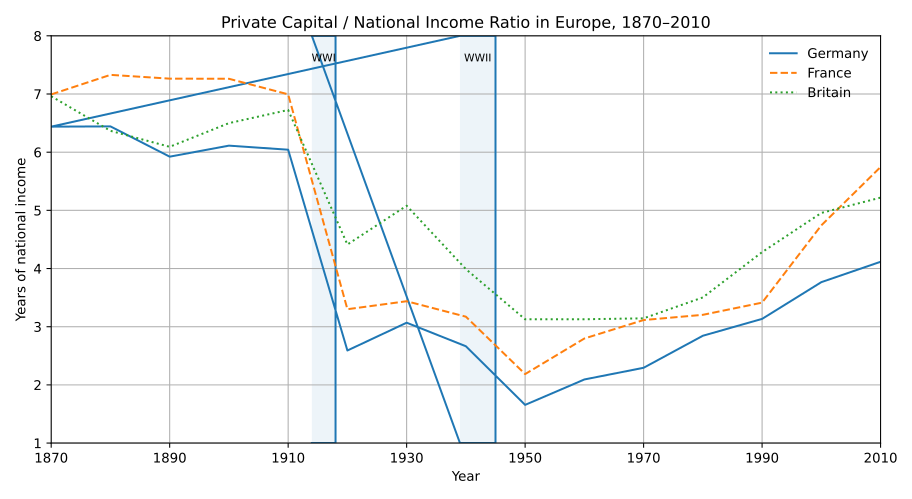
Figure 1. Private capital divided by national income in Germany, France, and Britain, 1870–2010. Source: Piketty, Capital in the Twenty-First Century, online figures and tables, Table SI.2.
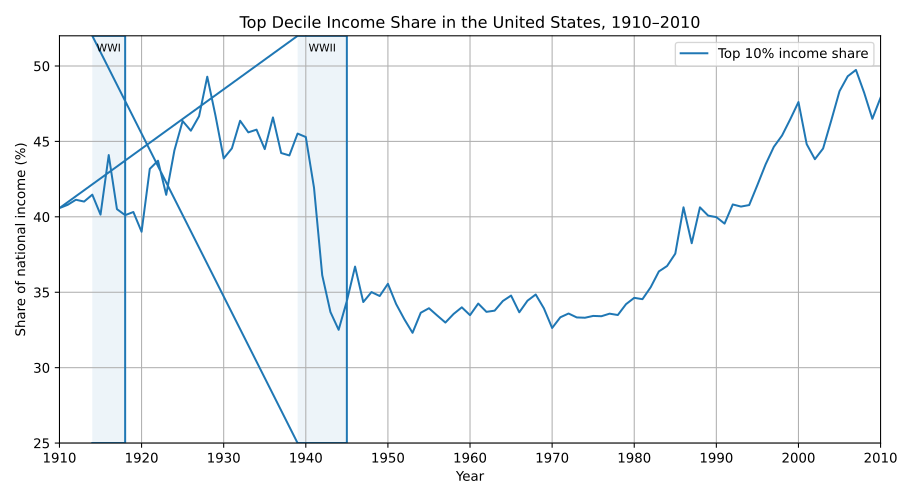
Figure 2. Proxy: Top decile income share in the United States, 1910–2010, including capital gains. Source: Piketty, Capital in the Twenty-First Century, online figures and tables, Table SI.1.
The most important fact is this: there are only exceptional historical moments when the rate of exploitation falls sharply. These moments are not ordinary moments of capitalist development. They are moments of world war. More precisely, they are moments of imperialist world war. This distinction matters. I am not speaking about local wars, proxy wars, or ordinary military conflicts. I am speaking about world war as a special historical form: a war that emerges from a crisis of capitalism itself and reorganizes the whole world.
The First World War is the clearest case. Before it, the imperialist powers had already expanded, conquered markets, and divided much of the world. The Law of Realization had operated. Yet the rate of exploitation functions like an internal counter of capital. When this counter reaches a historical limit, capitalism enters a crisis in which normal reproduction becomes increasingly impossible. Capital’s typical trajectory of realization is interrupted at this juncture. The system starts to decay internally, precipitating a crisis of capitalism.
This is why the First World War should be understood as a crisis of capitalism expressed in the form of world war. On the surface, the war appears as a struggle for the repartition of the world, for markets, territories, colonies, and spheres of influence. But in a deeper sense, the war is meaningless for capital in the immediate sense. It does not solve the problem by simply giving one capitalist power another piece of territory. Its meaning lies elsewhere: it violently interrupts the previous structure of accumulation and creates the conditions for a fall in the rate of exploitation.
This can be seen historically. After the First World War, and especially through the wider crisis period that followed, the relation between capital and labor shifted. In Europe, private capital relative to national income collapsed. In the data, Germany, France, and Britain all show a sharp fall from the prewar period to the mid-twentieth century. For example, the average private capital/national income ratio in these countries falls from roughly 6.6 years of national income around 1910 to roughly 2.3 years around 1950, before later rising again toward approximately 5 years by 2010. This is not a minor shift; it represents a monumental, historical decline in the power of capital.84
The same logic appears in the United States around the Second World War. The American top decile income share was extremely high before the war, fell sharply during and after the war, and later rose again in the neoliberal period. Again, the point is not to accept every interpretation that economists attach to these figures. The point is that the movement itself is visible: capital’s dominance falls in connection with world war and then gradually returns.85
Scholars may explain this fall in different ways. They may speak about physical destruction, inflation, taxation, nationalization, capital controls, the welfare state, labor mobilization, or the destruction of rentier wealth. These explanations matter, but the most important point at this stage is the historical fact itself: world war leads to a fall in the rate of exploitation. The mechanism may include many mediations, but the pattern is visible. Ordinary wars do not produce the same historical effect. World war does.
This is why world war must be treated as a special type of war. It is the war-form of a crisis of capitalism. The crisis of capitalism connected to the historical limit of exploitation and the world war that follows from it are not separate phenomena. They are internally connected.
The Second World War is more complicated than the First. It was also an imperialist world war, but the world situation was different. Its consequences were uneven. After the Second World War, the fall of exploitation appears especially clearly in the United States, while Europe and other regions must be understood through a more complex historical configuration. This will require a separate analysis in later works. For now, the important point is that the Second World War also belongs to the same general logic: capitalism entered a systemic crisis, world war reorganized the conditions of reproduction, and the internal relation between capital and labor was reset.
This reset is what I call the second breath of capitalism. The second breath is the moment when capitalism, after entering a crisis connected to the historical limit of exploitation, passes through world war and receives a renewed capacity to reproduce itself. War itself is not profitable for capital in a simple, immediate sense. War is destruction. Yet its consequences can be functional for capital, because they lower or reset the rate of exploitation internally and allow the cycle of accumulation to begin again from a new historical point.
This is the law of the second breath. Whenever capitalism reaches a historical limit in the rate of exploitation, it enters a crisis of capitalism. This crisis is not the same as an ordinary crisis of overproduction, nor is it simply a depression or recession. It is a deeper crisis of the capitalist system itself. Its world-historical form is world war. Through world war, the internal structure of exploitation is reset, and capitalism receives a renewed capacity to continue.
At first glance, this might seem to answer Marx in favor of capitalism: capitalism reaches its limit, destroys, resets itself, and continues. But this is not the conclusion. The world is more complex than a simple mechanical collapse, but this does not abolish the basic truth of Marx’s critique. It only modifies the historical form in which that truth appears.
This chapter therefore begins with exploitation, but it also opens toward later work. The connection between imperialist war, the fall of exploitation, and the emergence of anti-capitalist forms such as the Soviet Union or China is not accidental. These phenomena are internally connected, but their full explanation belongs to later studies. Here, the task is more limited: to identify the rate of exploitation as the internal counter of capitalism, to show its historical tendency to rise, and to define the second breath as the world-historical reset that follows when this tendency reaches its limit.
Literature Review on Exploitation and the Second Breath
The literature concerning inequality, crisis, and capitalist recovery gives us two lines of evidence. The first line proves that exploitation gradually rises upward, meaning the relation of capital income to labor income. This also includes the concentration of wealth and, in general, the growth of the power of those who have over those who do not have. The second line concerns the moments when this growth is interrupted, when this movement breaks. This allows us to examine the story from two sides.
The central author on inequality, in my opinion, is Piketty, especially his work Capital in the Twenty-First Century.86 There he showed that the relation between capital income and labor income is unstable. It rose to very high levels before the First World War, then collapsed in the middle of the twentieth century, and then began to rise again after the neoliberal turn. His central formula, where , shows the structural advantage of accumulated wealth over income. When the return on capital exceeds growth, this leads to a situation where wealth accumulates faster than wealth is created. That is, people who own capital receive more than what is being created, and therefore the process develops unevenly. Ideally, they should be equal, at least in the sense that and should be equal, and then every increase in the economy would give an equal increase to both sides. But this does not happen: growth gives more to capital. I used his tables in the previous subsection to show this.87
In general, the same thing is shown by the World Inequality Report.88 It also shows that the world is mostly owned by a tiny minority, while everyone else owns nothing or owns a shrinking amount of wealth.
U.S. distributional national accounts by Piketty, Saez, and Zucman show a post-1980 collapse in the income share of the bottom half and a surge for the top 1 percent. Initially, this was a labor-income shift, but after 2000 it became a capital-income phenomenon, suggesting a return to a rentier structure based on inherited assets.89
The same tendency is also confirmed by other authors who use different arguments.90
Saez and Zucman confirm the same picture, but they also show that the state itself becomes an exploiter by shifting the tax burden onto the people, as we already discussed.91
Further, Piketty also discusses how capital declined, or more precisely how the relation of capital income to labor income fell between 1914 and 1945.92 He explained this in different ways: world wars, major revolutions, the Great Depression, inflation, and so on. This does not concern us yet. The fact remains: he himself saw that in these periods, which I call periods of the crisis of capitalism, exploitation fell. Again, in another work, Capital and Ideology, Piketty says that the collapse of power was largely mediated by political decisions, such as nationalization, the expropriation of international assets, and so on.93 But, for example, the World Inequality Report places emphasis on the fact that wars and crises reduced the wealth of the richest, while progressive taxation or nationalization came after the wars. The primary factor was precisely wars and crises. Again, this agrees with my own view.94
Another author, Atkinson, placed more emphasis on the postwar period, specifically on the fact that inequality decreased because of progressive taxation, social provision, wage compression, and so on.95 In essence, the author says that what happened during the war was later institutionalized. This institutionalization is now gradually ending in the modern period. In other words, war and crises broke the old structure, while policy and labor power shaped the postwar settlement.
Marxist literature, for example Grossmann, shows that the destruction and devaluation caused by war were necessary conditions for creating space for capital accumulation.96 In this way, war destroyed values and weakened the breakdown tendency. Of course, this strongly resembles my own idea, and even the name “breathing space” overlaps with it.
Mandel, in turn, directly connects this process with the rate of surplus value.97 He emphasizes that fascism, in his view, and the Second World War created the necessary conditions for raising the rate of surplus value, which ultimately led to a radical erosion of the value of labor-power. His analysis is interesting, but in the next parts of the work I will express my own view on fascism and, possibly, on the whole of the Second World War.
Another author also put forward his own hypotheses and theories about what wars ultimately are and why capital wars occur. His specific explanation was that when ordinary crises and competition become insufficient for the transformation of the capitalist structure, the so-called business cycle becomes a cycle of world wars.98 Of course, as I already said in relation to Mandel, I understand what he is trying to say, but I do not fully agree. Later, I will give my own view of what world wars are. I already expressed something on this, and I will say more, for example, about the Second World War. In my opinion, Marxist authors often place too much emphasis on desire, as if the capitalist simply wanted something. But we must speak precisely about laws. Therefore, everything cannot be explained through desires, even if this is only a metaphorical expression. Obviously, capital did not especially want war. Of course, at the very moment when the war began, it could be profitable in the immediate sense, but it is not profitable in the long-term perspective. And, of course, as already said, war is generally destructive for capital and becomes useful only after the fact.
Kliman expressed an interesting thought, because for him the destruction experienced by capital during the Great Depression and the Second World War created the necessary condition for the postwar boom.99 I basically agree with this, because this is a direct expression of the so-called second breath. As we can see, authors also connect precisely world wars, and also the Great Depression, although I do not place much emphasis on it. The Great Depression is a separate discussion. Of course, it does relate to the destruction of capital and to the boom that capitalism received after the wars, but this is not the main emphasis here. Again, I do not fully agree with the author, but the emphasis on wars is correct. Roberts expressed a similar thought in The Long Depression.100 They placed emphasis on the destruction and devaluation of capital. But, as already said in my work, I do not place the emphasis on what exactly happened. For me, the moment of war itself is more important, and it is a more explanatory factor than the attempt to find other factors such as the destruction of capital. This may have happened, but whether it was directly connected with war or indirectly connected with it, and whether it was a cause rather than a consequence, I cannot yet assert.
In addition, there are other authors who explain the success of capitalism after crises, or at the end of crises, for example Brenner or Duménil and Lévy.101 Authors such as Shaikh show a general framework of capitalism as a competitive, conflictual, and crisis-driven system.102
As we can see, modern literature, both Marxist and non-Marxist, shows the same picture: the growth of inequality, which is sometimes interrupted, specifically during the period 1914–1945, which I connect with world wars. Other authors, of course, name many causes and many factors, and they often mix causes and consequences. But for this work, and for understanding what happened, this is not decisive. What matters is not the explanation, but the fact of what happened. And, as already said, the facts they show are enough to understand that we actually see what I described. That is, there is a growth of exploitation, or the law of the tendency of the rate of surplus value to rise, or the law of the tendency of exploitation to rise. At the same time, this tendency has the property of rolling back. This rollback, as I already said, is called the law of the second breath. It happened specifically after world wars. Even if there were other factors, such as the Great Depression, in fact the Great Depression was a consequence of the First World War for the United States, since in the First World War the United States did not really participate in the war itself, but traded through the war with Europe. This led to overheating. This, in turn, transferred the crisis to the whole world. But the Great Depression itself did not destroy capital in the same way, even if this also happened to some degree. Most importantly, it did not clearly and strongly bring down the level of exploitation. If we look at the graph, perhaps something like this happened, but it recovered very quickly. When we speak about real crises that can shake the system, we are speaking precisely about world wars, not about the Great Depression. As already said, this is a very interesting topic that requires a separate discussion. I will touch on it partly in the next chapter, where I will speak about the mefo-law.
The Mefo-law and Coercive Realization
The Mefo-law as the Fascist Form of the Law of Realization
In this chapter, we will discuss the so-called mefo-law. In essence, we are saying the following: if capitalism, or some developed industrial capitalist country, finds itself in a situation where it cannot realize itself spatially, that is, if it has no periphery, and if it also suffers from other pressures that suppress it, then what happens to this country? As it turns out, the law of realization still operates there. But it is transformed into the mefo-law.
The meaning remains the same. This is still the law of realization. We are not speaking about something completely new. Its concrete historical form changes, but this does not abolish the fact that it is still the same imperialist law.
I previously stated clearly, as I explained in the last chapter, that the crisis of capitalism is the cause of world war. This is true. It applies both to the First World War and to the Second World War. But one fact troubled me. Why did Germany, for example, have a low level of exploitation, given that it had recently come out of a war? Perhaps it had not yet reached the full historical minimum that it reached after the Second World War, but nevertheless it was already quite low.
As I said, the crisis of capitalism leads to world wars. But in Germany itself, there was no crisis of capitalism in my specific sense of the term, because the rate of exploitation had already fallen there after the First World War, according to Piketty.103 In Germany, the rate of exploitation, the rate of surplus value, the relation between capital income and labor income, had fallen after the First World War.
Then why was the country still in crisis? This is the key question. Although the Second World War was caused by the crisis of capitalism, one cannot say directly that Germany itself began the war because its own internal crisis of capitalism had reached the limit of exploitation. According to my theory, that specific crisis was not inside Germany. My first hypothesis works, but not completely. It works indirectly.
The problem was the law of realization. A capitalist country came out of crisis and had to develop further. It had to move outward. But the problem was that this country had lost. Instead of integrating Germany and forming friendly relations with it, as happened after the Second World War, Western imperialism entered into relations with Germany that essentially exploited it. This may sound strange, but Germany was in fact exploited. It was placed under reparations, the Dawes and Young arrangements, dependence on American credit, inter-Allied debt pressure, and the broader Versailles order.
Germany became the weak link. The pressure of the crisis of capitalism and the Great Depression fell largely on Germany. It also fell on Britain and France, but through the Versailles debt-reparation structure this pressure was transferred further onto Germany. The crisis in the United States forced Britain and France to repay their debts and interest to the United States as quickly as possible, and this intensified the pressure on Germany through the reparations system. Therefore, Germany suffered the most.
There was also another factor: Germany had lost all of its colonies after the First World War. A country that was constantly being strangled, and that had also lost all of its colonies, found itself in a complete dead end.
This is exactly what I described earlier. What happens to a country when it cannot realize its profit? Solvency falls, growth collapses, the economy begins to break down, unemployment rises, inflation can grow endlessly, and so on. The exact symptoms can vary, but the meaning is that the economy as a whole stops functioning adequately.
And at the very moment when credit money, loans, and external financial support stopped flowing into Germany, the country began to fascize. Fascist tendencies had existed before, but Germany began to fascize mainly when the support ended, when the Depression happened, and when external pressure intensified. Germany stopped being pulled back from the brink. It might have been able to pull itself out if it had possessed a periphery.
What does the law of realization say? It demands realization. As long as Germany was sustained by an artificial breathing system, by the artificial debt system of the United States and so on, it could somehow exist. But once this was switched off, the law had to operate clearly. Profit had to be realized. The economy had to function.
This led to the embodiment of the law of realization in reality. Germany began preparing to obtain territory. How did this happen? If we look at the facts, it happened through the law of debt and the law of outlet.
Germany began creating so-called MEFO bills and other similar financial instruments. Their meaning was essentially this: we, the state, give you, the capitalists, money here and now, and you must produce machines, weapons, and so on. Then we, the state, will take these weapons and attack neighboring countries or other countries. We will expand our territory. And on the basis of what we obtain through this expansion, we will pay back the debt we created.
Thus, a kind of endless financial pyramid emerged. In order for this economy to continue functioning, it had to expand endlessly. In this sense, it resembles a tumor or cancer. What happens to a cell? The law of realization is like a normal property of a cell. But if you expose the cell to radiation and damage its function, it can become cancerous. In the same way, the mefo-law is the same law of realization, but in a country that has fallen into this situation because of the crisis of capitalism.
Germany did not fall into this situation randomly. It fell into it because of the crisis of capitalism: pressure from the United States through financial, credit, and indirectly reparational instruments, and also through the Great Depression, which itself happened partly because the United States overheated during the First World War by earning too much from that war. While the European countries were fighting, the crisis in them was being reduced. That is the logic.
In short, there was a crisis of capitalism in the world. It did not end with the First World War. Rather, it partly shifted and concentrated in the United States. The United States experienced enormous growth because of the First World War, precisely because of this first partial resolution. But this also overheated its economy. As a result, the economy burst into the Great Depression, and this spread to the rest of the world. This led the United States to pressure Britain, France, and Germany more aggressively. Debt and reparational pressure increased. At the same time, Germany had already lost its territories and colonies after the First World War.
Because of all this, Germany found itself in a situation where the law of realization could not be embodied, even though it had to be. The law had to operate, but it could not operate in the normal way. And since a law must embody itself, we see its embodiment in the form of the mefo-law.
The mefo-law means fascization. Everything else develops around it and leads toward it. Around the mefo-law, fascism grows. Fascism is the embodiment of the law of realization in the form of the mefo-law.
This is why the term mefo-law is taken from fascist Germany and from the word MEFO bills. The MEFO bills performed precisely this function. You take debt from the future in order to cover it later through the conquest of neighboring territories, through expansion, through obtaining a periphery, through obtaining an outlet.
The law operates simultaneously through outlet and through debt. This is why, as I said in previous chapters, these two sides are one and the same. The law of realization appears simultaneously as the law of debt and as the law of outlet.
Fascism is the mefo-law. Germany is an excellent example because there the process happened literally. The MEFO bills literally expressed what the law means. This is why I use the word mefo. The German case gives the clearest historical form, but the law itself is wider than Germany.
The United States and the Transmission of the Interwar Crisis
Before moving to the literature review on Germany, it is first necessary to examine the United States as a necessary precondition. We cannot really understand the German case by looking only inside Germany itself. The blocked German position was, in essence, a consequence of the internal crisis of capitalism in the United States after the First World War, and of everything that followed from it: the rise of the United States, the debt-reparations circuit of the 1920s, the American credit boom, and the sudden reversal of capital flows at the end of the decade.
The First World War radically changed the position of the United States. It pushed the United States to the first place in the world economy. Ahamed describes this as a shift of the financial center of the world, or, in my understanding, the imperialist center of the world, from London to New York.104 After the war, the United States emerged with a huge economy, abnormal gold reserves, a strengthened Federal Reserve, and a creditor position over the European Allied powers.105 Hannigan argues the same thing when he notes that the Great War, that is, the First World War, marked the transition of the United States into a world power, while the European states exhausted themselves through the war, both financially and militarily.106 Costigliola makes essentially the same point.107
Keynes showed that this was not merely some diplomatic or geopolitical movement. It was a material and financial shift. Already in 1919, he saw that Europe had become dependent on the United States, on American food supplies, American credit, and American financial support more generally.108 Ahamed also points out that the Allied powers owed enormous sums of money to the United States.109 Kindleberger, in turn, argues that what we see in the interwar period is essentially a weakness of the international system. Britain could no longer perform the stabilizing role that it had played before 1914, while the United States had become strong enough to replace Britain, but, in his view, did not assume the responsibility of hegemonic stabilization that Britain had previously carried.110 Again, his argument is interesting, but in essence this is explained by the crisis of capitalism in the United States itself, which we observed through the data discussed earlier.111
This rise of the United States created a specific financial situation in the 1920s. Germany owed reparations to Britain and France. Britain and France owed war debts to the United States. The United States then lent money to Germany, Germany used those funds to pay reparations, and Britain and France used those payments to service their debts to the United States. Ahamed describes this as a circular system of debt and payment.112 Other authors, such as Tooze and Eichengreen, also point to the same circular nature of the situation around debt, reparations, and payments between the United States, Britain, France, and Germany.113
The Dawes Plan, and later the Young Plan, created a mechanism of artificial stabilization in Germany, a kind of artificial breathing system. Ritschl argues that the Dawes Plan encouraged heavy German borrowing by prioritizing commercial and foreign loans over reparations.114 Schuker goes even further and, in a sense, says something that I also use ironically in my own work: Germany received much more international capital than it ultimately paid out in reparations, which in his view resembled “American reparations” to Germany.115 Thus, Germany was fully tied to the stabilization provided by the external American credit system. In this sense, one can say that fascization did not happen earlier precisely because Germany was artificially supported: its law of realization was, for a time, being realized while Germany remained connected to the United States.
Harold James shows how deeply this international credit system was embedded in the Weimar economy. The German economy, business, public finance, and industrial rationalization became dependent on international funds, and especially on funds from the United States.116 Neumann also argues that the stability of the Weimar Republic was, in essence, fictitious, because it depended on international loans.117 Sohn-Rethel also points out that this debt support allowed Germany to rebuild its industry and agriculture in the second half of the 1920s, but at the same time made Germany dependent on the continuation of external lending.118
The role of the United States in all this was double. On the one hand, it temporarily kept Germany alive, essentially as an artificial breathing system. On the other hand, it made Germany deeply dependent on a system that Germany itself did not control. What stabilized Germany also made it vulnerable to American financial movements. Germany relied on, and sustained itself through, external credit.
This is why the American boom of the late 1920s is essential. Kindleberger argues that the boom on the New York stock exchange diverted American capital away from foreign lending even before the full crash of 1929.119 Ahamed argues that American bankers stopped investing in Berlin as returns inside the United States rose, shifting capital inward toward speculation rather than outward toward European stabilization.120 Costigliola also emphasizes that the international system was fragile because it relied on continuous Wall Street loans, and that it began to weaken even before the stock market crash.121
Eichengreen argues that the gold standard spread American monetary tightening across the world. U.S. rate increases and gold flows forced countries with weak reserves, such as Germany, toward deflation, thereby producing a global contraction.122
At the moment when lending from America stopped, Germany collapsed. James describes this through the German banking crisis and the internal breakdown of the German economy.123 Kindleberger also connects the withdrawal of foreign lending with the German banking crisis and, ultimately, with the broader disintegration of the international economy.124 Tooze argues that Germany’s significant foreign debt by the early 1930s compelled the Nazis to abandon the American-dependent strategy, and this became a key turning point.125
The Great Depression resulted from the collapse of the U.S.-centered world financial structure. After the First World War, the United States became a major creditor, stabilized Europe through loans, and then overheated through the stock market boom. After that, the United States spread the crisis by withdrawing credit, breaking the old lending mechanism, and halting international lending, with Germany becoming one of the key points where this pressure was concentrated.126
Thus, the logic is the following. Germany did not enter this special crisis by itself. This crisis was not the crisis of capitalism in the strict sense described earlier. Germany entered it as a defeated and blocked capitalist country. Its recovery and support depended on American credit. At the moment when this credit mechanism broke down, Germany could no longer rely on the external debt-reparations circuit. The law of realization still demanded realization, but the old external financial mechanism had collapsed. The Nazi response was to construct a new internal mechanism: hidden debt, state military demand, labor discipline, autarky, and future expansion.
Literature Review of the Mefo-law and Coercive Realization
Polanyi argued that the collapse of the international liberal order, the gold-standard system, and the self-regulating market created the conditions for fascism. In his account, fascism is a political solution to the crisis of market society, which eventually appears through the destruction of democratic institutions and the reorganization of society around the needs of production, order, and state power.127 Again, this is his own interpretation. But the facts remain facts: the consequences and collapses that appeared in the world of imperialism led to fascism.
Poulantzas rejected the idea that fascism appeared from one single economic factor. For him, fascism was the result of many factors, such as conjunctural class struggle, crisis of hegemony, monopoly capital, state transformation, and the political defeat of the working class.128 Again, this is his older Marxist interpretation, in my understanding. As in the case of Polanyi, it makes sense, but it still does not fully explain what was really happening there. The main value is that he saw many factors, including the ones he named, and those factors also deserve attention.
Neumann, in Behemoth, described Nazi Germany as totalitarian monopoly capitalism. That is, a system in which private property remains, monopoly power expands, and the state commands the economy through a totalitarian apparatus.129 In his work, one can notice his emphasis on the dual nature of the German Nazi economy. This is very important. On the one hand, capital remains private; on the other hand, the conditions of accumulation become politically organized.
Sohn-Rethel argued that the fascist economy improved capital accumulation by depressing consumption and shifting toward absolute surplus-value extraction. For him, the state takes over the entrepreneurial and managerial function, while capital remains private and receives the benefits.130 Again, as with other authors, I cannot fully agree with his opinion, because although we do see this concrete manifestation, it is still a consequence of the mefo-law, that is, the law of realization in its highest form of expression during this kind of crisis, which, as already stated, is not an ordinary crisis of capitalism. But his argument still confirms the fact that fascism is the political form through which blocked capitalism reorganizes its realization through debt, labor discipline, and then, of course, future expansion.
According to Poulantzas, the Nazi economy promoted industrial development, technological innovation, and productivity growth, while at the same time intensifying exploitation and class domination.131 This means that fascism was not simply capitalism destroying itself. Rather, it was capital reorganized under specific historical conditions. In other words, we are not saying that capitalism disappeared. It reorganized itself under the pressure of the law of realization, like a cancerous tumor, searching further for ways of outlet.
Tooze’s The Wages of Destruction details MEFO finance: Mefo GmbH, a dummy company funded by large industrial firms, paid armament contractors with MEFO bills redeemable at the Reichsbank.132 This system turned future obligations into present military demand. James confirms that MEFO pre-financed rearmament, with the Reichsbank discounting MEFO-drawn supplier bills under an unwritten Reich guarantee.133 Aly highlights this hidden debt, calling MEFO notes promissory instruments from a fictional private enterprise used to conceal state liabilities.134
The thoughts of Schacht himself are also interesting as technical testimony. He describes MEFO bills as bills of exchange and emphasizes that they could be treated almost as interest-bearing money.135 Of course, his subjective defense does not matter much for this chapter. Whatever he thought he had created the mechanism for, the mechanism performed the function that it performed.
Harvey provides a theoretical mechanism for this process. Capitalism creates fictitious capital, which is then directed toward future-oriented projects that are needed to absorb surplus capital and labor.136 MEFO bills fit Harvey’s logic very strongly, because this is exactly what they were created for. We are not speaking simply about money. These were debts created in the present for the production of military goods, employment, and industrial drive, but against future conquest.
Overy should also be mentioned. In his work, he argues that it is very poor to claim simply that capital controlled the state. He shows that firms such as Krupp and the Ruhr industrialists did, of course, benefit greatly from the processes taking place, but later became too dependent on the political regime, which rewrote their ordinary business rationality.137 Of course, this is his opinion, and no one is claiming that capital controls the state directly in the most primitive sense. But capital nevertheless directed the state, and this was obvious. The meaning of the law of realization is not that capital is very evil and directly controls the state. The point is that its relations and needs are concentrated in the state. The way this happens can vary. It does not necessarily mean that some person came and said: let us attack neighboring countries. No. It means that the whole logic of capital required realization. It flowed into MEFO bills, and the state, even if it was completely autonomous and independent from everyone, lived on the logic of MEFO bills and on the specific interaction with capital that had already formed.
Aly expands the argument by showing that Germany did not only exploit its own workers, and I agree with this. The opposite view is too primitive for capitalism. Capital does not mainly exploit only its own workers; it also exploits the external environment. Aly shows that the pressure of the Nazi economy, according to the movement of the law of realization, fell precisely on external countries and not only on Germany itself.138 Thus, this critique works against classical Marxism when classical Marxism says that capitalism is self-enclosed and exploits only itself internally. No, this is an insufficient view. Capitalism is, of course, also self-enclosed and exploits itself internally. That is a fact. But the consequences of capitalism, or imperialism, are visible outside, in the zone of realization, which is exactly what we saw in the case of Germany and in what Germany did.
Studies on Schacht’s New Plan and the Four Year Plan show that Germany shifted to controlled trade, import rationing, bilateral clearing, autarky, and military buildup. Neumann argues that the New Plan used foreign exchange control to prioritize rearmament.139 James adds that foreign exchange shortages necessitated bilateral trade and administrative import allocation.140 Tooze links radicalization to the Four Year Plan, citing Hitler’s 1936 mandate for the German military and economy to be war-ready in four years.141 Overy also points to autarky, synthetic resources, domestic iron ore, and Central and Eastern European integration as key preparations for a future war economy.142
Sohn-Rethel gave one of the sharpest theoretical interpretations of this movement. He argued that when Germany could no longer buy the raw materials it needed, and when the internal rearmament process could no longer stop without undermining the foundation of the entire system, annexation became the direct way of obtaining what could not be bought.143 This is where the law of realization manifests itself as the law of outlet. The blocked economy creates military production through debt, but the validation of this production requires an external space.
Many historians challenge the idea that economic collapse forced Germany into war and instead point to strategic political decisions. Tooze believes Hitler started the war for strategic reasons rather than because the economy was falling apart.144 Overy argues that military and international factors were more important than domestic economic problems.145 Schacht claims the economy was under control until Hitler pushed military spending too far.146 Schuker and Ritschl emphasize that political strategy and debt management were the real drivers rather than a simple lack of money.147
Their arguments can confirm only one point: the economy, in its visible form, did not look like something that was about to collapse immediately. But economic collapse as such was not the reason why Germany wanted to realize its profit. In general, it is clear that these authors are mostly trying to argue against Marxists, that is, against Marxist arguments that the economy was collapsing, falling apart, and so on. But in fact, they still did not refute the general logic that capital wanted to realize itself.
Even the argument that Germany was functioning is complicated, because it was functioning as a militarized country, as a country completely dependent on the militarization of the economy. It stood entirely on military rails. Therefore, to say that the economy was functioning, and then to argue that when it began war this had nothing to do with economic causes because the economy was functioning, is a very weak counterargument. The economy was functioning, but it was functioning on military rails.
As already stated, the question was not whether the economy was collapsing or not collapsing. The law of realization precisely implies that the economy will not collapse for some time while it is moving toward realization. What we saw after Hitler’s rise to power was the organization of the economy against the direction in which it had previously been moving because of the impossibility of realization. The economy essentially said: I will realize myself, and I will go and realize myself. That is what it did. Accordingly, it survived. But historians treat this survival as a counterargument against the process of fascization and realization. It is not a counterargument. Again, the issue is not whether the economy was visibly falling apart. The issue is what it was becoming, and for what purpose.
In the end, Keynes, Trachtenberg, Ahamed, Costigliola, Kindleberger, Eichengreen, James, Ritschl, Schuker, and Marks explain that Germany was shaped by the Versailles Treaty, lost resources, reparations, and a heavy reliance on American loans.148 Kalecki, Neumann, Poulantzas, Mason, Polanyi, and Sohn-Rethel show how the government used political force to reorganize labor, monopoly capital, and employment.149 Tooze, James, Schacht, Aly, Overy, Neumann, and Sohn-Rethel reveal the specific tools used: MEFO bills, hidden debt, trade controls, and the plan to seize resources from other countries.150
Thus, we can conclude that the simple phrase “economic collapse caused the war” is incorrect, because there was no simple economic collapse in Germany. Germany was a blocked capitalist country whose recovery occurred through a military-debt mechanism. The law of realization operated through the law of debt and the law of outlet. MEFO bills and the later expansion of the economy and war were expressions, on the one hand, of the law of debt, and on the other hand, of the law of outlet. Thus, Germany is the purest manifestation of the mefo-law, and this is why the law is named after the German case.
This shows how a capitalist country from which the area of realization has been taken away, that is, the normal sphere of spatial realization, can reorganize its economy through debt-financed militarization, and then seek the external completion of that process through conquest.
The main point is that the German situation is actually quite plain. It is not some supernatural or absolutely exceptional situation. Historians, both Western and Eastern, Marxist and non-Marxist, could not understand for a long time what the meaning of Germany and similar countries was. But the meaning is the same as the meaning of capitalism itself: the law of realization. That is all. Fascization was not simply connected to itself. We did not merely strangle a country. In a normal situation, this is impossible — not physically impossible, but impossible because there is no meaning or profitability in it. We saw this immediately after the Second World War. After that war, Germany was no longer strangled. On the contrary, it was developed, and today Germany is one of the most developed countries in the world.
But again, it was precisely the situation that formed around the United States that led to fascization, and the United States itself was in a crisis of capitalism. The crisis of capitalism itself, this highest form, this finality of capital, led to the fascization of Germany. It is even unclear which was worse: the First World War, which was the direct and literal expression of the crisis of capitalism, that is, the war of Europe; or the Second World War, which was the mediated expression, not exactly indirect but conditionally mediated, of the crisis of capitalism already centered in the United States, but now expressed through fascism, Nazism, militarism, and so on.
Conclusion
In this work, I have tried to answer the questions that were posed at the beginning. The central question was simple: how is capitalist profit realized as profit for the system as a whole?
The answer developed here is the law of realization. Capitalism does not only have to produce surplus value. It must also transform this surplus value into money-profit through effective demand. Production alone is not enough. A commodity may contain surplus value, but this surplus value is not completed for capital until it is sold and returned as money. Therefore, the problem of capitalism is not only the production of surplus value but also its realization.
This law was not introduced as an arbitrary invention. It was developed through the logic already present in Marx, Luxemburg, Sweezy, Baran and Sweezy, Kalecki, Minsky, Godley, Harvey, and other authors. These authors showed, in different ways, that capitalism faces a systemic problem of realization, effective demand, surplus absorption, debt, crisis, and expansion. What I have done here is to name this logic more directly and to show that it operates as a law of capitalist reproduction.
The law of realization appears in two main forms.
The first form is the law of debt. Debt realizes profit in time. When present effective demand is insufficient, capitalism pulls future income into the present. Household debt pulls future wages into the present. Corporate debt pulls future profits into the present. Public debt pulls future taxes, fiscal capacity, and state power into the present.
The second form is the law of outlet. Outlet realizes profit in space. Capitalism searches for external spaces of realization: markets, labor, resources, territories, peripheral zones, and dependent economies. Through outlet, capitalism creates and maintains the periphery as a space of unequal exchange, extraction, subordination, and degradation. The periphery is not simply found by capital. It is produced by capital as a spatial solution to the realization problem.
Debt and outlet are not two separate solutions that can simply replace one another. They are two axes of the same law. Debt is the temporal axis of realization. Outlet is the spatial axis of realization. In real capitalism, they operate together. Debt finances expansion, and outlet validates debt.
After this, I shifted the analysis toward exploitation, crisis, and historical reset. I showed that exploitation can be understood through the relation between capital income and labor income, that is, through the monetary expression of the relation between surplus value and variable capital. On this basis, I analyzed the movement of exploitation, its historical growth, its crisis, and what I call capitalism’s second breath. The second breath means that capitalism resets itself.
The final part of the work examined the extreme political form of the same logic. In the case of Nazi Germany, the problem of realization did not appear as an ordinary market difficulty alone. It became reorganized through the state, military production, hidden debt, forced expansion, and the destruction of the old limits imposed on German capital. In this sense, Nazi Germany was used as an example of how the law of realization can take a coercive and fascized form. I call this form the mefo-law: a situation in which blocked realization is transformed into debt-financed militarization, expansion, and fascization.
This work was written as a necessary theoretical foundation for what comes next. If capitalism, according to its own laws, produces crisis internally and degradation externally, then the development of the East — or, more broadly, the Global South — cannot be explained as the normal result of capitalism. If the East develops instead of simply becoming a degraded outlet of capital, then another logic must be operating there.
This is why the law of realization is necessary for the further theory of anti-capital and polar Marxism. It shows what capitalism can do, what it cannot do, and where its limits appear. It also shows how the laws analyzed here produce the concrete form of the periphery under capitalist domination. The law of realization produces the periphery as outlet, while the “law of crisis” — that is, the law of capitalism’s second breath — shows how capitalist crisis, reset, destruction, and reorganization eventually rupture the peripheral form from within.
On this basis, it becomes possible to criticize modern superficial interpretations of the world: world-systems analysis, Western-centered theories of development, and explanations of China and the East as ordinary capitalism, state capitalism, or simple relocation of capital. The next task is to show what emerges beyond the normal movement of capital: the development of the East, the appearance of another historical logic, and the concept of anti-capital.
Footnotes
-
Karl Marx, Capital: A Critique of Political Economy, Volume II: The Process of Circulation of Capital, ed. Friedrich Engels (Moscow: Progress Publishers, 1885), https://www.marxists.org/archive/marx/works/download/pdf/Capital-Volume-II.pdf; Karl Marx, Capital: A Critique of Political Economy, Volume III: The Process of Capitalist Production as a Whole, ed. Friedrich Engels (New York: International Publishers, 1894), https://www.marxists.org/archive/marx/works/download/pdf/Capital-Volume-III.pdf; Rosa Luxemburg, The Accumulation of Capital, trans. Agnes Schwarzschild (London: Routledge; Kegan Paul, 1913), https://www.marxists.org/archive/luxemburg/1913/accumulation-capital/; Paul M. Sweezy, The Theory of Capitalist Development: Principles of Marxian Political Economy (New York: Oxford University Press, 1942), https://archive.org/details/in.ernet.dli.2015.461479; Paul A. Baran and Paul M. Sweezy, Monopoly Capital: An Essay on the American Economic and Social Order (New York: Monthly Review Press, 1966), https://monthlyreview.org/9780853450733/monopoly-capital/. ↩
-
Sweezy, The Theory of Capitalist Development; Marx, Capital, 1894. ↩
-
Marx, Capital, 1894; Marx, Capital, 1885. ↩
-
Luxemburg, The Accumulation of Capital, 1913. ↩
-
Marx, Capital, 1885. ↩
-
Marx. ↩
-
Luxemburg, The Accumulation of Capital, 1913; Marx, Capital, 1885. ↩
-
Sweezy, The Theory of Capitalist Development; Marx, Capital, 1885. ↩
-
Luxemburg, The Accumulation of Capital, 1913. ↩
-
Sweezy, The Theory of Capitalist Development. ↩
-
Marx, Capital, 1894. ↩
-
Sweezy, The Theory of Capitalist Development. ↩
-
Baran and Sweezy, Monopoly Capital. ↩
-
Marx, Capital, 1885; Marx, Capital, 1894; Luxemburg, The Accumulation of Capital, 1913; Sweezy, The Theory of Capitalist Development; Baran and Sweezy, Monopoly Capital. ↩
-
Marx, Capital, 1885; Marx, Capital, 1894; Luxemburg, The Accumulation of Capital, 1913; Sweezy, The Theory of Capitalist Development; Baran and Sweezy, Monopoly Capital. ↩
-
Hyman P. Minsky, “The Financial Instability Hypothesis” (The Levy Economics Institute of Bard College, 1992), https://www.levyinstitute.org/pubs/wp74.pdf. ↩
-
Minsky. ↩
-
Wynne Godley and Marc Lavoie, Monetary Economics: An Integrated Approach to Credit, Money, Income, Production and Wealth (London: Palgrave Macmillan, 2007), https://doi.org/10.1007/978-1-137-08599-3. ↩
-
Godley and Lavoie. ↩
-
Marc Lavoie, Post-Keynesian Economics: New Foundations (Cheltenham: Edward Elgar, 2014), https://www.elgaronline.com/monobook/book/9781839109621/9781839109621.xml. ↩
-
Hyman P. Minsky, Stabilizing an Unstable Economy (New Haven: Yale University Press, 1986), https://www.levyinstitute.org/publications/stabilizing-an-unstable-economy. ↩
-
Michał Kalecki, Theory of Economic Dynamics: An Essay on Cyclical and Long-Run Changes in Capitalist Economy (London: George Allen; Unwin, 1954), https://digamo.free.fr/kalecki54.pdf. ↩
-
Kazimierz Laski and Herbert Walther, “Kalecki’s Profit Equation After 80 Years,” wiiw Working Paper (The Vienna Institute for International Economic Studies, April 2013). ↩
-
Laski and Walther. ↩
-
Kalecki, Theory of Economic Dynamics. ↩
-
Kalecki. ↩
-
S. Jay Levy and David A. Levy, “Profits: The Views of Jerome Levy and Michał Kalecki” (The Levy Economics Institute of Bard College, 2000), https://www.econstor.eu/bitstream/10419/186979/1/wp309.pdf. ↩
-
Levy and Levy. ↩
-
Kalecki, Theory of Economic Dynamics. ↩
-
Kalecki. ↩
-
Wynne Godley, “Seven Unsustainable Processes: Medium-Term Prospects and Policies for the United States and the World” (The Levy Economics Institute of Bard College, 1999), https://www.levyinstitute.org/pubs/sr/sevenproc.pdf. ↩
-
Godley, “Seven Unsustainable Processes.” ↩
-
Godley and Lavoie, Monetary Economics. ↩
-
Godley and Lavoie. ↩
-
Lavoie, Post-Keynesian Economics. ↩
-
Lavoie. ↩
-
Kalecki, Theory of Economic Dynamics. ↩
-
Minsky, Stabilizing an Unstable Economy. ↩
-
Wolfgang Streeck, Buying Time: The Delayed Crisis of Democratic Capitalism, trans. Patrick Camiller (London; New York: Verso, 2014), https://www.versobooks.com/products/14-buying-time. ↩
-
Streeck. ↩
-
Streeck, Buying Time. ↩
-
Streeck. ↩
-
Greta R. Krippner, Capitalizing on Crisis: The Political Origins of the Rise of Finance (Cambridge, MA: Harvard University Press, 2011), https://www.hup.harvard.edu/books/9780674066199. ↩
-
Krippner. ↩
-
Krippner, Capitalizing on Crisis. ↩
-
Streeck, Buying Time. ↩
-
Streeck. ↩
-
Lavoie, Post-Keynesian Economics; Godley, “Seven Unsustainable Processes”; Minsky, Stabilizing an Unstable Economy. ↩
-
U.S. Department of the Treasury, “Debt to the Penny” (Fiscal Data, U.S. Treasury, 2026), https://fiscaldata.treasury.gov/datasets/debt-to-the-penny/; U.S. Department of the Treasury, “Debt to the Penny: Current Debt” (TreasuryDirect, 2026), https://www.treasurydirect.gov/NP_WS/debt/current; Federal Reserve Bank of St. Louis, “Federal Debt: Total Public Debt (GFDEBTN)” (FRED, Federal Reserve Economic Data, 2026), https://fred.stlouisfed.org/series/GFDEBTN; Congressional Budget Office, “The Budget and Economic Outlook: 2025 to 2035” (Congressional Budget Office, January 2025), https://www.cbo.gov/publication/60870; Congressional Budget Office, “Monthly Budget Review: Summary for Fiscal Year 2025” (Congressional Budget Office, November 2025), https://www.cbo.gov/publication/61307. ↩
-
John A. Hobson, Imperialism: A Study (London: James Nisbet, 1902), https://oll.libertyfund.org/titles/hobson-imperialism-a-study. ↩
-
Rudolf Hilferding, Finance Capital: A Study of the Latest Phase of Capitalist Development (London: Routledge; Kegan Paul, 1981), https://www.marxists.org/archive/hilferding/1910/finkap/. ↩
-
Vladimir Ilyich Lenin, Imperialism, the Highest Stage of Capitalism: A Popular Outline (Moscow: Progress Publishers, 1917), https://www.marxists.org/archive/lenin/works/1916/imp-hsc/. ↩
-
Nikolai Bukharin, Imperialism and World Economy (Monthly Review Press, 1929), https://www.marxists.org/archive/bukharin/works/1917/imperial/. ↩
-
Baran and Sweezy, Monopoly Capital. ↩
-
Rosa Luxemburg, The Accumulation of Capital, trans. Agnes Schwarzschild (London: Routledge; Kegan Paul, 1951), https://www.marxists.org/archive/luxemburg/1913/accumulation-capital/. ↩
-
Samir Amin, Accumulation on a World Scale: A Critique of the Theory of Underdevelopment (New York: Monthly Review Press, 1974), https://monthlyreview.org/9780853452720/accumulation-on-a-world-scale/; Samir Amin, Imperialism and Unequal Development (New York: Monthly Review Press, 1977). ↩
-
Amin, Accumulation on a World Scale; Amin, Imperialism and Unequal Development. ↩
-
Amin, Accumulation on a World Scale; Amin, Imperialism and Unequal Development. ↩
-
Amin, Accumulation on a World Scale; Amin, Imperialism and Unequal Development. ↩
-
Andre Gunder Frank, Capitalism and Underdevelopment in Latin America: Historical Studies of Chile and Brazil (New York: Monthly Review Press, 1967), https://archive.org/details/capitalismunderd0000fran_f8s6. ↩
-
Immanuel Wallerstein, The Modern World-System I: Capitalist Agriculture and the Origins of the European World-Economy in the Sixteenth Century (New York: Academic Press, 1974), https://archive.org/details/modernworldsyste00wall; Immanuel Wallerstein, “The Rise and Future Demise of the World Capitalist System: Concepts for Comparative Analysis,” Comparative Studies in Society and History 16, no. 4 (1974): 387–415, https://doi.org/10.1017/S0010417500007520. ↩
-
Raúl Prebisch, “The Economic Development of Latin America and Its Principal Problems” (United Nations Economic Commission for Latin America, 1950), https://archivo.cepal.org/pdfs/cdPrebisch/002.pdf; Hans W. Singer, “The Distribution of Gains Between Investing and Borrowing Countries,” The American Economic Review 40, no. 2 (1950): 473–85, https://link.springer.com/chapter/10.1057/9781137271631_19. ↩
-
Arghiri Emmanuel, Unequal Exchange: A Study of the Imperialism of Trade (New York: Monthly Review Press, 1972), https://monthlyreview.org/9781685901431/unequal-exchange/. ↩
-
Charles Bettelheim, “Additional Comments,” in Unequal Exchange: A Study of the Imperialism of Trade (New York: Monthly Review Press, 1972), https://monthlyreview.org/9781685901431/unequal-exchange/. ↩
-
Oscar Braun, Comercio Internacional e Imperialismo (Buenos Aires: Siglo Veintiuno Argentina Editores, 1973), https://books.google.com/books/about/Comercio_internacional_e_imperialismo.html?id=VlmRNAEACAAJ. ↩
-
Jason Hickel et al., “Imperialist Appropriation in the World Economy: Drain from the Global South Through Unequal Exchange, 1990–2015,” Global Environmental Change 73 (2022): 102467, https://doi.org/10.1016/j.gloenvcha.2022.102467; Jason Hickel, Morena Hanbury Lemos, and Felix Barbour, “Unequal Exchange of Labour in the World Economy,” Nature Communications 15, no. 1 (2024): 6298, https://doi.org/10.1038/s41467-024-49687-y. ↩
-
Hobson, Imperialism. ↩
-
Hilferding, Finance Capital. ↩
-
Lenin, Imperialism, the Highest Stage of Capitalism; Bukharin, Imperialism and World Economy; Wallerstein, The Modern World-System I; Wallerstein, “The Rise and Future Demise of the World Capitalist System”; Frank, Capitalism and Underdevelopment in Latin America; Amin, Accumulation on a World Scale; Amin, Imperialism and Unequal Development. ↩
-
David Harvey, The New Imperialism (Oxford: Oxford University Press, 2003), https://doi.org/10.1093/oso/9780199264315.001.0001; David Harvey, “The ‘New’ Imperialism: Accumulation by Dispossession,” Socialist Register 40 (2004): 63–87. ↩
-
Harvey, The New Imperialism; Harvey, “The ‘New’ Imperialism.” ↩
-
Harvey, The New Imperialism; Harvey, “The ‘New’ Imperialism.” ↩
-
Harvey, The New Imperialism; Harvey, “The ‘New’ Imperialism.” ↩
-
Giovanni Arrighi, “Spatial and Other ‘Fixes’ of Historical Capitalism,” Journal of World-Systems Research 10, no. 2 (2004): 527–39. ↩
-
Arrighi; Giovanni Arrighi, The Long Twentieth Century: Money, Power, and the Origins of Our Times (London; New York: Verso, 2010). ↩
-
Arrighi, “Spatial and Other ‘Fixes’ of Historical Capitalism.” ↩
-
Arrighi, The Long Twentieth Century. ↩
-
Arrighi, “Spatial and Other ‘Fixes’ of Historical Capitalism”; Arrighi, The Long Twentieth Century. ↩
-
Giovanni Arrighi, “States, Markets and Capitalism, East and West,” in Semin’ario Internacional REG GEN: Alternativas Globalização (Rio de Janeiro: UNESCO; CLACSO, 2005), http://bibliotecavirtual.clacso.org.ar/ar/libros/reggen/pp25.pdf. ↩
-
Arrighi, “Spatial and Other ‘Fixes’ of Historical Capitalism”; Arrighi, The Long Twentieth Century. ↩
-
Arrighi, “States, Markets and Capitalism, East and West.” ↩
-
Arrighi, “Spatial and Other ‘Fixes’ of Historical Capitalism”; Arrighi, The Long Twentieth Century. ↩
-
Thomas Piketty, “Capital in the Twenty-First Century: Online Figures and Tables” (Online companion to Capital in the Twenty-First Century, 2014), https://piketty.pse.ens.fr/capital21c. ↩
-
Piketty. ↩
-
Piketty. ↩
-
Thomas Piketty, Capital in the Twenty-First Century, trans. Arthur Goldhammer (Cambridge, MA: The Belknap Press of Harvard University Press, 2014). ↩
-
Piketty, “Capital in the Twenty-First Century,” 2014. ↩
-
Lucas Chancel et al., “World Inequality Report 2022” (World Inequality Lab, 2021), https://wir2022.wid.world. ↩
-
Thomas Piketty, Emmanuel Saez, and Gabriel Zucman, “Distributional National Accounts: Methods and Estimates for the United States,” The Quarterly Journal of Economics 133, no. 2 (2018): 553–609. ↩
-
Loukas Karabarbounis and Brent Neiman, “The Global Decline of the Labor Share,” The Quarterly Journal of Economics 129, no. 1 (2014): 61–103; Anthony B. Atkinson, Inequality: What Can Be Done? (Cambridge, MA: Harvard University Press, 2015); Simcha Barkai, “Declining Labor and Capital Shares,” 2016; David Autor et al., “Concentrating on the Fall of the Labor Share,” NBER Working Paper (National Bureau of Economic Research, 2017). ↩
-
Emmanuel Saez and Gabriel Zucman, The Triumph of Injustice: How the Rich Dodge Taxes and How to Make Them Pay (New York: W. W. Norton & Company, 2019); Gabriel Zucman, The Hidden Wealth of Nations: The Scourge of Tax Havens, trans. Teresa Lavender Fagan (Chicago: University of Chicago Press, 2015). ↩
-
Piketty, Capital in the Twenty-First Century, 2014. ↩
-
Thomas Piketty, Capital and Ideology, trans. Arthur Goldhammer (Cambridge, MA: The Belknap Press of Harvard University Press, 2020). ↩
-
Chancel et al., “World Inequality Report 2022.” ↩
-
Atkinson, Inequality. ↩
-
Henryk Grossmann, The Law of Accumulation and Breakdown of the Capitalist System: Being Also a Theory of Crises, trans. Jairus Banaji (London: Pluto Press, 1992). ↩
-
Ernest Mandel, Late Capitalism (London: New Left Books, 1975), https://www.marxists.org/archive/mandel/1972/latecap/index.html. ↩
-
Paul Mattick, Marx and Keynes: The Limits of the Mixed Economy (Boston: Extending Horizons Books, 1969), https://www.marxists.org/archive/mattick-paul/1969/marx-keynes/index.htm. ↩
-
Andrew Kliman, The Failure of Capitalist Production: Underlying Causes of the Great Recession (London: Pluto Press, 2012). ↩
-
Michael Roberts, The Long Depression: How It Happened, Why It Happened, and What Happens Next (Chicago: Haymarket Books, 2016). ↩
-
Robert Brenner, The Economics of Global Turbulence: The Advanced Capitalist Economies from Long Boom to Long Downturn, 1945–2005 (London; New York: Verso, 2006); Gérard Duménil and Dominique Lévy, Capital Resurgent: Roots of the Neoliberal Revolution, trans. Derek Jeffers (Cambridge, MA: Harvard University Press, 2004). ↩
-
Anwar Shaikh, Capitalism: Competition, Conflict, Crises (Oxford: Oxford University Press, 2016). ↩
-
Piketty, “Capital in the Twenty-First Century,” 2014. ↩
-
Liaquat Ahamed, Lords of Finance: 1929, the Great Depression, and the Bankers Who Broke the World (New York: The Penguin Press, 2009). ↩
-
Ahamed. ↩
-
Robert E. Hannigan, The Great War and American Foreign Policy, 1914–24 (Philadelphia: University of Pennsylvania Press, 2017). ↩
-
Frank Costigliola, Awkward Dominion: American Political, Economic, and Cultural Relations with Europe, 1919–1933 (Ithaca; London: Cornell University Press, 1984). ↩
-
John Maynard Keynes, The Economic Consequences of the Peace (London: Macmillan, 1919). ↩
-
Ahamed, Lords of Finance. ↩
-
Charles P. Kindleberger, The World in Depression, 1929–1939 (Berkeley; Los Angeles: University of California Press, 1973). ↩
-
Piketty, “Capital in the Twenty-First Century,” 2014. ↩
-
Ahamed, Lords of Finance. ↩
-
Adam Tooze, The Wages of Destruction: The Making and Breaking of the Nazi Economy (London: Allen Lane, 2006); Barry Eichengreen, Golden Fetters: The Gold Standard and the Great Depression, 1919–1939 (New York: Oxford University Press, 1992). ↩
-
Albrecht Ritschl, “The German Transfer Problem, 1920–1933: A Sovereign Debt Perspective” (CEP Discussion Paper No. 1155, Centre for Economic Performance, London School of Economics, 2012). ↩
-
Stephen A. Schuker, American “Reparations” to Germany, 1919–33: Implications for the Third-World Debt Crisis (Princeton: International Finance Section, Department of Economics, Princeton University, 1988). ↩
-
Harold James, The German Slump: Politics and Economics, 1924–1936 (Oxford: Clarendon Press, 1986). ↩
-
Franz L. Neumann, Behemoth: The Structure and Practice of National Socialism (New York: Oxford University Press, 1942), https://archive.org/details/in.ernet.dli.2015.236979. ↩
-
Alfred Sohn-Rethel, The Economy and Class Structure of German Fascism (London: Free Association Books, 1987). ↩
-
Kindleberger, The World in Depression, 1929–1939. ↩
-
Ahamed, Lords of Finance. ↩
-
Costigliola, Awkward Dominion. ↩
-
Eichengreen, Golden Fetters; Barry Eichengreen and Peter Temin, “The Gold Standard and the Great Depression,” Contemporary European History 9, no. 2 (2000): 183–207. ↩
-
James, The German Slump. ↩
-
Kindleberger, The World in Depression, 1929–1939. ↩
-
Tooze, The Wages of Destruction. ↩
-
Kindleberger, The World in Depression, 1929–1939; Eichengreen, Golden Fetters; Ahamed, Lords of Finance. ↩
-
Karl Polanyi, The Great Transformation: The Political and Economic Origins of Our Time (New York: Farrar & Rinehart, 1944). ↩
-
Nicos Poulantzas, Fascism and Dictatorship: The Third International and the Problem of Fascism (London: New Left Books, 1974), https://archive.org/details/fascismdictators0000poul. ↩
-
Neumann, Behemoth. ↩
-
Sohn-Rethel, The Economy and Class Structure of German Fascism. ↩
-
Poulantzas, Fascism and Dictatorship. ↩
-
Tooze, The Wages of Destruction. ↩
-
James, The German Slump. ↩
-
Götz Aly, Hitler’s Beneficiaries: Plunder, Racial War, and the Nazi Welfare State (New York: Metropolitan Books, 2007). ↩
-
Hjalmar Horace Greeley Schacht, The Magic of Money (London: Oldbourne, 1967). ↩
-
Harvey, The New Imperialism. ↩
-
R. J. Overy, War and Economy in the Third Reich (Oxford: Clarendon Press, 1994). ↩
-
Aly, Hitler’s Beneficiaries. ↩
-
Neumann, Behemoth. ↩
-
James, The German Slump. ↩
-
Tooze, The Wages of Destruction. ↩
-
Overy, War and Economy in the Third Reich. ↩
-
Sohn-Rethel, The Economy and Class Structure of German Fascism. ↩
-
Tooze, The Wages of Destruction. ↩
-
Overy, War and Economy in the Third Reich. ↩
-
Schacht, The Magic of Money. ↩
-
Schuker, American “Reparations” to Germany, 1919–33; Ritschl, “The German Transfer Problem, 1920–1933.” ↩
-
Keynes, The Economic Consequences of the Peace; Marc Trachtenberg, Reparation in World Politics: France and European Economic Diplomacy, 1916–1923 (New York: Columbia University Press, 1980); Ahamed, Lords of Finance; Costigliola, Awkward Dominion; Kindleberger, The World in Depression, 1929–1939; Eichengreen, Golden Fetters; James, The German Slump; Ritschl, “The German Transfer Problem, 1920–1933”; Schuker, American “Reparations” to Germany, 1919–33; Sally Marks, “The Myths of Reparations,” Central European History 11, no. 3 (1978): 231–55. ↩
-
Michał Kalecki, “Political Aspects of Full Employment,” The Political Quarterly 14, no. 4 (1943): 322–30; Neumann, Behemoth; Poulantzas, Fascism and Dictatorship; Tim Mason, Nazism, Fascism and the Working Class (Cambridge: Cambridge University Press, 1995); Polanyi, The Great Transformation; Sohn-Rethel, The Economy and Class Structure of German Fascism. ↩
-
Tooze, The Wages of Destruction; James, The German Slump; Schacht, The Magic of Money; Aly, Hitler’s Beneficiaries; Overy, War and Economy in the Third Reich; Neumann, Behemoth; Sohn-Rethel, The Economy and Class Structure of German Fascism. ↩
How to cite this article
Vilen Isteni (2026). "The Law of Realization." Polar Marxism. https://polarmarxism.com/en/research/law-of-realization

Discuss the Study
Email me if you want to discuss this research.